The disturbances feared in central Valencia did not take place on Saturday, 31 October, but many businesses had already closed or cut trading in response to warnings attributed to Blocus. The precautions came as the city prepared for Halloween and followed unrest and looting threats reported in Barcelona and Bilbao. Valencia’s preventive operation ran from Friday, 30 October, into the early hours of Sunday, 1 November.
On 30 October, Valencia City Council announced that the Local Police would double the security deployment planned for Halloween night. The wider operation involved the Policía Nacional, Policía Local, Guardia Civil, the regional police unit assigned to the Valencian Community and private security personnel. Mayor María José Catalá and government delegate Roger Llanes discussed the response at a meeting of the Junta Local de Seguridad at city hall. The plan focused on protecting shops and maintaining public order in the historic centre.
Mayor Catalá had written to Interior Minister Fernando Grande-Marlaska on 27 October requesting additional police resources and a coordinated plan to protect residents, shops and businesses. Authorities treated the warnings as a preventive security concern, not as evidence of an incident in Valencia. ABC reported that police and the Guardia Civil had detained an alleged Blocus leader and two young people, aged 17 and 18, over suspected calls for disturbances and alleged instructions related to preparing Molotov cocktails. These were allegations reported by police, not convictions.
Agencia EFE reported the initial estimates after speaking to sector associations. Manuel Espinar, president of the Federación de Hostelería Valencia, put the hospitality sector’s lost turnover at about 70% compared with a normal Saturday. He said around 40% of central Valencia’s hospitality venues closed; those that remained open saw fewer customers. The estimate reflected closures and reduced activity after the threat, rather than losses from rioting in the city.
The shortfall also affected lunchtime trade. Some establishments recorded customer numbers down by more than 35%, Espinar said. Levante-EMV also reported his initial estimate of a loss of about 70% in hospitality turnover compared with a normal Saturday. He warned that sudden closures could affect businesses beyond the immediate loss of trade.
For retailers, the expense of securing premises varied by business. Alfredo González, vice-president of the Asociación de Comerciantes del Centro Histórico de València, said members had reported costs of between €1,000 and €10,000 while the association continued to assess the overall impact. Its 500 members include jewellery shops, clothing retailers and hospitality businesses. Separately, Las Provincias reported that some association members faced up to €10,000 in lost revenue, while some businesses spent about €2,500 protecting shopfronts or hiring private security.
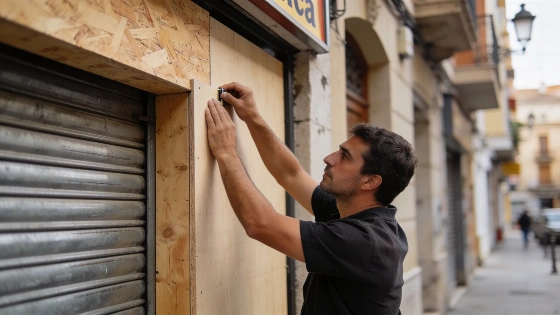
González said almost all the association’s small businesses closed from 4pm, following precautionary guidance to protect staff and customers. Some fitted wooden boards; others installed iron doors. Businesses were also advised to reinforce shutters, remove vulnerable or high-value merchandise from displays, and check locks and CCTV. He said the eventual financial loss could exceed the initial estimates because some shoppers had stayed home from Thursday afternoon.
The associations said they had coordinated with the Ayuntamiento de València and the Delegación del Gobierno, which passed on recommendations and safety measures. Protecting employees and customers was their stated priority. RUSSPAIN has also covered questions of political accountability after major incidents in its reporting on accountability.
Rafael Torres, president of Confecomerç, said around two-thirds of businesses had planned either to remain closed or to shut at 4pm. He also pointed to lost sales during a weekend that coincided with month-end and the payment of wages, and urged serious consideration of how to respond to similar threats. Torres said threats of looting and damage should not bring a city’s economic activity to a halt.