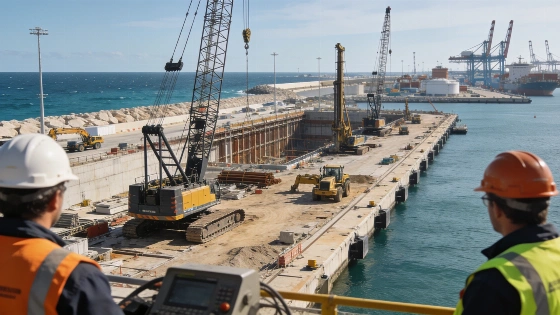
Valencia's Superior Court has rejected a major environmental appeal against the €660 million northern expansion of the Port of Valencia, ruling that the original 2007 environmental declaration remains valid. The decision clears the way for construction.
The northern expansion of the Port of Valencia will move ahead after the Superior Court of Justice of the Valencian Community dismissed the basic legal challenge and confirmed that the 2007 environmental declaration still applies. The decision removes the last impressive legal obstacle to the €660 million container terminal project, which has faced years of criticism and opposition from environmental groups. El Español reports that the court found the 2007 declaration remains in force for the current phase because the first phase was never completed and the second is considered a continuation of the same project.
The dispute centered on whether the updated 2021 project, approved by the Port Authority in December 2022, required a new environmental impact assessment. The court ruled that the original 2007 declaration still covers the works: the first phase was unfinished, and the second is part of the same overall project. The judges found that, despite the changes introduced in 2021, the project did not qualify as a new initiative under environmental law, so no new or simplified assessment was needed. El Español reports that the court said the modifications, though large, did not create new impressive environmental impacts under Spanish regulations.
Environmental group Acció Ecologista Agró argued that the scale of the changes and possible new impacts, including increased maritime traffic and higher emissions, as well as potential effects on the Albufera Natural Park, required a new review. The court disagreed, finding that the expert report supporting the claim did not address specific technical questions, including emissions and resource use, and relied too heavily on earlier documents that did not consider later project changes. Instead, it gave greater weight to a 2022 technical report commissioned by the Port Authority, describing it as methodologically sound and persuasive in its conclusion that no new assessment was necessary. El Español reports that the judges considered the port authority's technical documentation more strong and up to date than the environmentalists' submissions.
The ruling also clarified that other legal disputes involving the port, including those over passenger terminal concessions and the logistics zone, were not part of this case. The court found no legal or factual errors in the approval of the container terminal expansion and said the process had no defects that would invalidate it. The decision applies only to the northern expansion, not to other ongoing or future disputes over the port's wider development.
The decision can still be appealed to the Supreme Court, but construction can now proceed without further environmental review. The outcome is likely to fuel debate in Valencia, where infrastructure projects often spark environmental and political tensions. The court’s reliance on technical documentation over activist concerns reflects a pattern in Spanish administrative law, where established procedures and institutional expertise often outweigh calls for new scrutiny. In a region already marked by political divides, as seen in the recent investigation into political clashes, the ruling shows that, for now, legal precedent and established processes will set the pace for major public works. The verdict highlights the continued influence of legacy approvals in Spain’s infrastructure sector, even as environmental standards and public expectations change.