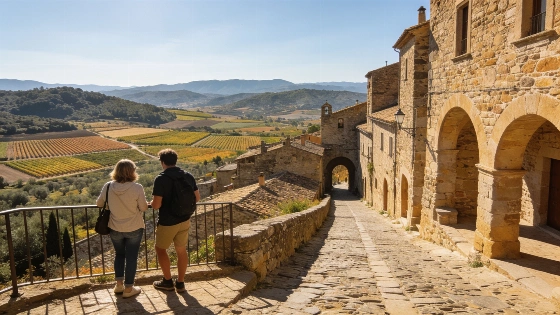
Pals in Baix Empordà stands out for its medieval core, panoramic views, and landscapes that echo Tuscany. Just a short drive from Barcelona, this Catalan village blends stone architecture, rice fields, and coastal proximity for a uniquely rich escape.
Sun hits the old stone walls in Pals. This Girona village draws travelers who want more than just the usual Costa Brava beaches. Pals sits on a gentle hill. Its medieval center still stands strong, with sweeping views over the Empordà plain. Regional tourism sources confirm Pals is a top spot in Baix Empordà, known for its preserved medieval streets and wide-open vistas.
Pals does not just look like Tuscany. Its old center rises above the fields, giving the village a commanding view. You can still see its defensive roots in every narrow lane and archway. But the place feels alive, not frozen in time. Climb the Torre de les Hores, the village’s landmark tower. The view from the top brings Italy to mind—fields, stone houses, and changing light. Independent guides note the Torre de les Hores dates to the 11th or 12th century. It is the symbol of Pals’ medieval past.
The rice fields (arrossars) surrounding Pals, along with the nearby Basses d’en Coll wetlands, create a unique landscape that sets the village apart from the classic Tuscan image.
Pals moves at a slower pace than the crowded Costa Brava coves. You can cross the old center in minutes. The real reward comes when you stop at the high points. Below, rice fields, wetlands, and the distant sea stretch out in every direction. The church of Sant Pere anchors the village. Its layers of history and changing architecture show how time has shaped Pals. Every street and plaza offers a new angle, especially when the sun is low and the stone glows. Local publications point out that the mix of medieval buildings and rice fields makes Pals stand out from other villages nearby.
Spring turns the fields green. Autumn brings ochre and gold. Even in summer, when the coast is packed, the Baix Empordà countryside stays calm. The rice fields around Pals are rare for this region. They flatten the land and set off the village’s height. The Basses d’en Coll wetlands are close by. Birdlife and walking trails give visitors a taste of the area’s wild side. The municipality also includes Platja de Pals, a beach about 3.5 kilometers long. Together with the wetlands, it offers a mix of medieval, rural, and coastal experiences.
Getting to Pals by car is simple. Take the main roads from Barcelona through Girona and into Baix Empordà. Public transport works, but you need to plan ahead and check train and bus times. If you are short on time, the Ca la Pruna tourism office is a good place to start your visit.
According to independent travel guides, the journey from Barcelona to Pals typically takes about 1 hour 40 minutes by car and around 2 hours 45 minutes by bus, making the 'less than ninety minutes' claim more of a marketing simplification than a universal reality. The tourism office in Ca la Pruna regularly updates seasonal hours and contact details to assist visitors in planning their trips.
To get the most out of a day in Pals, split your time. Spend the morning in the old town. Fewer people and better light make it the best time to see the Torre de les Hores, Sant Pere, and the village viewpoints. In the afternoon, head out to the rice fields and wetlands. If the weather is good, you can end the day at the beach.
If you have more time, check out nearby villages. Peratallada is dense with medieval stonework. Monells has a small arcaded square and a cozy feel. Ullastret offers Iberian ruins for those who want a deeper dive into history.
Timing matters. Spring and autumn bring the best light, mild weather, and fewer crowds. In summer, go early or late. Winter strips things down: clear skies, empty streets, and a village that shows its true texture.
Travel patterns in Catalonia are changing. More people now look for real places and landscapes, not just beaches. As reported earlier, storms and weather extremes can ruin coastal plans. Villages like Pals, with their steady charm, become even more appealing when the weather turns.
Pals is not a place you can sum up in one photo or a checklist. Its draw comes from the mix of stone, field, and sea. All of it sits close enough to Barcelona to make the trip worth it. For those who look past the obvious, Pals proves that Catalonia’s best moments often happen away from the crowds. Here, history and the land still set the pace.