A senior Valencian official confirmed in court he was alerted to the red weather warning via WhatsApp. The testimony highlights gaps in emergency response during the deadly October 2024 floods. Key decisions and missed warnings are now under judicial scrutiny.
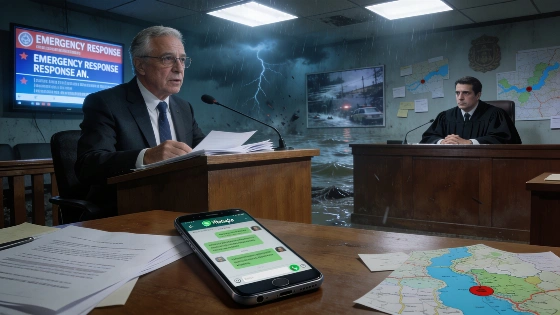
Valencian authorities are facing renewed scrutiny after Ignacio Grande, the region’s Secretary for Social Services and Family, testified before a judge that he was notified of the red alert for the October 2024 dana via WhatsApp. Grande stated that the message, sent at 7:51 a.m. on the day of the catastrophic flooding, came from Emilio Argüeso, then Director General of Emergencies. This revelation, confirmed by sources present at the hearing, has intensified questions about the effectiveness and coordination of the regional government’s emergency response.
According to Grande, Argüeso shared public data about the flooding in a group chat for senior officials throughout the day, with updates continuing until 2:00 p.m.—just before then-president Carlos Mazón began a lengthy lunch at El Ventorro restaurant. Despite the ongoing flow of information, Grande’s superior, Vice President Susana Camarero, left the regional emergency coordination center (Cecopi) in the afternoon to attend an awards ceremony. Meanwhile, Mazón maintained his official schedule, which included three morning events, the extended lunch, and a walk through central Valencia with a journalist.
Grande acknowledged that his department was not warned in advance about the potential impact of the storm on social services, nor did he receive information from Cáritas, which had requested a suspension of activities the day before the storm. He also admitted that during the Cecopi meeting, which he joined by videoconference, he did not raise concerns about the risk to elderly care homes in the event of a dam failure at Forata, a structure whose collapse could have resulted in thousands of deaths according to regional estimates. The first official confirmation of flooding at the Paiporta care home, where six elderly residents died, came at 8:21 p.m. Grande also noted that no one in the crisis committee mentioned the threat posed by the Barranco del Poyo, the ravine that devastated towns like Paiporta and Catarroja.
Throughout the day, Grande relayed notes to Vice President Camarero, including a 5:21 p.m. update that around 100 people were stranded on rooftops due to the flooding. Despite these warnings, Camarero left for a business event with the regional roads minister. Grande attributed the leadership of Cecopi to then-Justice and Interior Minister Salomé Pradas, describing her as proactive in proposing evacuations and lockdowns—measures that were ultimately not implemented. This account contradicts Pradas’s own testimony in April 2025, where she claimed she had no operational control over the emergency response, emphasizing her lack of knowledge to avoid legal liability.
Grande said he could not recall whether anyone at Cecopi communicated with Amparo Fort, the mayor of Chiva, who testified that she alerted the provincial government to the extreme situation in her municipality at 5:00 p.m. on October 29, 2024. This detail suggests the Generalitat may have been aware of the crisis in the Barranco del Poyo area three hours before the mass Es-Alert notification was sent to residents at 8:11 p.m.—by which time most of the missing had already died. The judge, Nuria Ruiz Tobarra, is focusing her investigation on the timing of this alert, as the case centers on potential charges of negligent homicide and injury, which carry prison sentences of up to four and three years, respectively.
This testimony adds to a growing body of evidence about the region’s handling of the disaster. As previously reported, a senior official from the Confederación Hidrográfica del Júcar criticized Mazón’s preparedness when he arrived at the emergency center, challenging earlier claims about the government’s crisis management (see detailed analysis here).
The October 2024 dana was one of the deadliest weather events in recent Valencian history, with flash floods causing significant loss of life and property. The judicial investigation is now focused on whether earlier warnings or different decisions could have mitigated the tragedy. The case has highlighted the importance of clear communication and decisive action during emergencies, especially when vulnerable populations such as care home residents are at risk. The outcome of the probe may influence future protocols for crisis management across Spain, as authorities seek to prevent similar failures in the face of increasingly frequent extreme weather events.