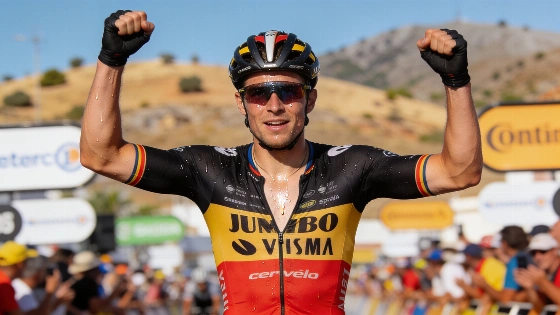
Wout van Aert powered to victory in Loja after a punishing day marked by crashes and withdrawals. Enric Mas kept the leader’s jersey as the peloton splintered and teams worked to contain threats. The toll on riders was severe.
Wout van Aert took control of stage 13 at La Vuelta a España with a well-timed attack near Loja, breaking up the lead group and adding to a growing list of battered riders. The Belgian’s move in the final kilometers split the breakaway and forced teams to rethink their plans, while Enric Mas quietly held onto his overall lead amid the chaos.
The stage was aggressive from the start. The heat in Granada was relentless, and the race was on almost as soon as the riders left Almuñécar. Early breakaways ballooned to nearly half the peloton, with Van Aert, Brennan, Buitrago, Skjelmose, and Pello Bilbao all gambling on a day that offered little relief. Movistar, with no one up front, had to defend Mas’s red jersey from unexpected threats.
The official La Vuelta video channel highlighted Van Aert as the main protagonist of the stage, underlining his decisive role in the breakaway and final victory.
La Vuelta Official Video Channel
As the kilometers passed, the damage mounted. Gregor Mühlberger crashed on the first big climb and had to abandon, a setback for Felix Gall’s mountain support. UAE Team Emirates lost Pavel Sivakov, adding to their problems after Pogacar’s earlier exit. Alpecin’s Busatto and Sentjens also withdrew, while David de la Cruz crashed but managed to continue, bruised but still riding. The high dropout rate showed just how tough the day was, both physically and tactically.
With the front group shrinking, alliances shifted in the main pack. Movistar got unexpected help from EF, Ineos, and Decathlon, each with their own reasons to keep the break’s lead in check. Their combined effort meant Mattias Skjelmose, who started the day seventh overall, never gained enough time to threaten Mas. The general classification stayed steady, but only after a day of constant calculation and shared work between rivals.
Van Aert’s ride was all about timing and endurance. He attacked several times, closed gaps, and finally broke clear with Valentin Paret-Peintre in the last 3.5 kilometers. Paret-Peintre tried to hold his wheel but couldn’t match Van Aert’s finishing speed. Matthew Brennan, Van Aert’s Visma teammate, helped control the chase group and took third, capping a strong day for the team.
The stage covered 192.8 km from Almuñécar to Loja, featuring key climbs such as Puerto de Granada. According to several cycling media outlets, the gap between Van Aert and third-placed Brennan at the finish was 24 seconds, emphasizing that the decisive move came from a select group rather than a mass sprint.
Cycling News and Official Race Reports
Loja, hosting a Vuelta finish for the first time, saw a two-man fight that left no doubt about the strongest rider. Van Aert’s win came from constant pressure and clear tactics, while Mas’s steady defense kept the leader’s jersey safe. But the day’s crashes and withdrawals left several teams with fewer riders for the rest of the race.
Granada’s heat has become a theme, with riders describing the feeling of racing "in an oven." The physical toll was obvious, and the aftermath will shape team strategies as the race heads into the mountains. The pattern of attrition and shifting alliances reflects the kind of high-stakes decisions seen in other recent Spanish sporting controversies, as reported in a recent incident involving local authorities and public safety.
What stands out from this stage is not just Van Aert’s strength, but how the peloton’s dynamics changed under pressure. Teams that usually compete worked together out of necessity, and the relentless pace exposed every weakness. The Vuelta remains unpredictable, and as the race moves forward, the ability to adapt—whether by attacking or just surviving—will decide who lasts. The events in Granada show that in cycling, as in much of Spanish sport, resilience and tactical clarity often make the difference between finishing and dropping out.