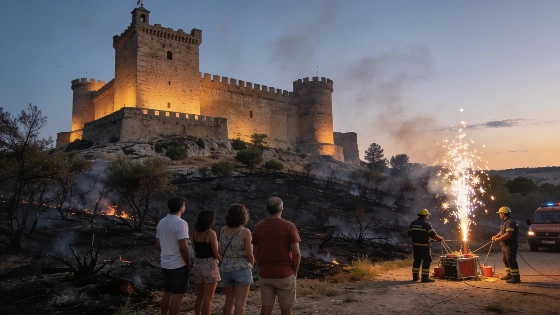
San Martín de Valdeiglesias will hold a fireworks show during its patronal festivities, despite recent wildfires and criticism over fire risks. The decision has sparked debate among residents and local politicians.
San Martín de Valdeiglesias, a municipality in Madrid’s Sierra Oeste still recovering from a wildfire that devastated over 27,000 hectares, has confirmed it will proceed with a large fireworks display during its patronal festivities from 2 to 13 September. The announcement has triggered strong criticism from opposition parties and residents, who point to the ongoing high fire risk and the visible scars left by the recent blaze.
The local council, governed by the Partido Popular (PP), argues that the fireworks show is a longstanding tradition and a key draw for visitors. Officials highlight that the event, organized by pirotecnia Vulcano, will take place in the urban center at the Castillo de la Coracera, and stress that in four decades, no fire incidents have occurred during previous editions. However, they acknowledge that the show will be cancelled if wind conditions are deemed unsafe.
Despite these assurances, the decision has not eased concerns. The PSOE’s spokesperson, Luis Haro, has labeled the 229,900-euro budget for bullfighting events as unnecessary, especially given the town’s current economic challenges. Local businesses have suffered a sharp drop in visitors this August, with the Pantano de San Juan’s chiringuitos still closed and the local economy stagnating at a time when it typically thrives. The council estimates the festivities could generate up to 1.2 million euros in revenue, positioning the events as a potential catalyst for recovery.
Residents and local politicians remain divided. Aitana Garrido, a Más Madrid deputy and local resident, notes the community is still deeply affected by the wildfire, and while she sees value in restoring a sense of normality, she questions the wisdom of holding a pyrotechnic event in an area officially designated as high fire risk and lacking in preventive measures. The debate echoes broader concerns about fire management in Spain, as highlighted by recent scrutiny of wildfire responses in other regions, such as the controversy over Valencia’s handling of the El Saler fire.
Meanwhile, the Pantano de San Juan remains closed, with ongoing tree removal work and no set reopening date. The continued closure has left many local businesses in limbo, compounding the economic strain. The council maintains that the festivities, including the fireworks and bullfighting events featuring well-known toreros like José María Manzanares, Andrés Roca Rey, and Alejandro Mora, were planned before the wildfire and are intended to support the town’s recovery.
San Martín de Valdeiglesias is not alone in facing the dilemma of balancing tradition, economic needs, and safety in the wake of severe wildfires. Across Spain, municipalities are under increasing pressure to adapt public events to changing climate risks. The situation in San Martín highlights the complex choices local authorities must make as they navigate recovery, public sentiment, and the realities of a region still marked by fire damage. The debate is likely to continue as the festivities approach and the community weighs the benefits of celebration against the risks that remain.