Spanish Referees Explained Controversial Decisions in La Liga Matches. The Technical Referees Committee reviewed controversial moments in La Liga matches. Special attention was given to incidents involving Real Madrid and Barça. Referee decisions and the work of VAR have raised questions from fans and experts.
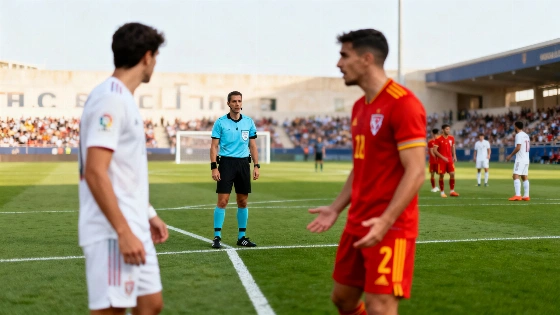
The Technical Refereeing Committee of Spain (CTA) publicly reviewed the controversial incidents from the penultimate round of La Liga, focusing on the key moments of the Sevilla — Real Madrid and Barça — Betis matches. The main discussion centered around refereeing decisions that sparked mixed reactions and raised questions about VAR's performance.
In the match at the Sánchez Pizjuán stadium, the main controversy arose after Vinicius's goal. In the build-up, Mbappé challenged Carmona. According to the CTA, the forward's actions could have been interpreted as a foul: using his arm clearly impeded the defender. However, the on-field referee considered the arm movement to be natural and not sufficiently forceful to warrant a foul. As a result, the goal stood, and VAR did not intervene, as it did not see a clear and obvious error—the incident was deemed controversial but not in need of review.
The second incident in the same match was Vinicius's fall after contact with Kike Salas in the penalty area. The CTA notes the defender's actions could have been considered dangerous, which usually results in a penalty and a caution. Nevertheless, due to the interpretative nature of the situation and the absence of clear roughness, the decision was left to the referee's discretion. VAR again did not intervene, concluding the situation did not meet the criteria for a clear and obvious error.
In the parallel match at Camp Nou, attention was drawn to an episode with the awarding of a penalty in favor of Betis. The referee saw a foul by Gavi on Isco, but VAR recommended a review of the decision. After reviewing the replay, the official upheld his opinion, although according to the CTA, there were no grounds for a penalty: Isco lost his balance on his own, without any defender's foul. The committee emphasized that in such cases, the referee should adjust his decision and restart the game with a dropped ball.
In the Levante — Mallorca match, the CTA supported referee Alberola’s decision to award a penalty for Virgili’s handball. According to the committee, the defender increased his body area and changed the ball’s trajectory, which meets the criteria for a penalty.
Questions about refereeing and VAR in Spanish football remain a subject of discussion not only among fans but also at the level of official bodies. Similar analyses of controversial decisions have already become the subject of publications – for example, in a piece about the balance of power in Spain’s Fiscal Council, where internal conflicts and the impact of decisions on the system were also examined. more on the distribution of powers in Spanish institutions.
For reference: the VAR system was introduced in La Liga in the 2018/19 season and has repeatedly faced criticism for its ambiguous interpretations. Refereeing decisions in Spain are regularly discussed on the special program Tiempo de Revisión, where the CTA explains its stance on the most controversial incidents. In recent years, issues regarding the transparency and consistency of refereeing decisions remain relevant for clubs and fans.