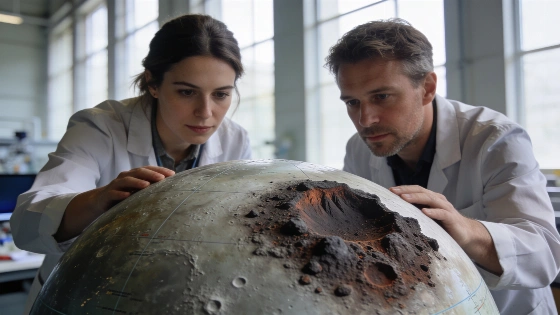
A study of Venus found a thinner lithosphere and more than twice as many volcanoes in the north. The result adds a north-south divide to models of how the planet loses internal heat.
Researchers compared Venus's gravity and topography with its geological provinces. The data indicate a thinner lithosphere in the north and more than twice as many volcanoes there as in the south. This pattern offers a new way to study how a planet close to Earth in size evolved without plate tectonics.
The international study was led by the Universidad Complutense de Madrid, with participation from the Universidad Rey Juan Carlos. Earth and Planetary Science Letters published the work. The thickness of Venus's rigid outer shell corresponds to the distribution of volcanic structures that release internal heat.
A thinner lithosphere lets heat escape more easily through volcanic activity. Venus is not built the same way everywhere.
Researchers already knew about the BAT anomaly, an unusually active volcanic zone. BAT refers to the elevated regions Beta, Atla and Themis, where volcanoes are concentrated. The new analysis found that the difference extends beyond this zone: the northern and southern hemispheres also differ across the rest of the planet.
The team reached that result by combining geological provinces with geophysical models. Alberto Jiménez Díaz of the Universidad Rey Juan Carlos said the researchers studied lithospheric thickness and the distribution of loads. They used gravity and topography data collected by Magallanes, the NASA probe launched in 1989 that orbited Venus for four years.
The researchers sorted the geophysical data by location, then compared it with the planet's geological divisions. Statistical tests checked whether the north-south contrast was real or the result of one isolated regional anomaly. The analysis found a difference outside the BAT zone as well.
That matters because Venus is the terrestrial planet closest to Earth in size, yet its geological history took a different path. It has no system that recycles its lithosphere in the way Earth's plate tectonics does. Volcano locations so offer impressive clues about how Venus cools inside.
ScienceInsights also describes Venus as a world whose surface and interior remain active areas of research. Studies have found signs of relatively recent or possibly continuing volcanic activity. Venus is not a static world.
The study's method also shows why regional measurements matter in planetary science. An earlier data breakdown in another field separated a daily movement from the wider pattern. The same distinction matters when isolated figures can hide a broader trend.
No single explanation yet accounts for the thinner northern lithosphere. Javier Ruiz of the Universidad Complutense de Madrid said the result now needs to be added to models of Venus's evolution. The team is also testing different ideas about how the split formed.
The Universidad Complutense de Madrid says future models must include the uneven nature of Venus's outer shell. Venus loses heat through a planet-wide north-south imbalance, a pattern future models will need to include.