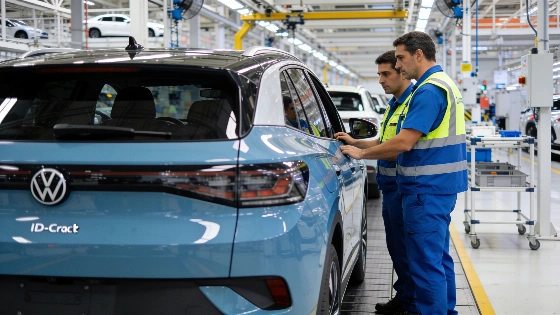
Volkswagen has begun production of the ID Cross in Navarra, completing the electrification of its Spanish factories. The group now aims for over one million vehicles annually across its Iberian plants, strengthening jobs and future investment.
Volkswagen has reshaped Spain’s automotive landscape by starting production of the Volkswagen ID. Cross at its historic Landaben plant in Navarra. This launch completes the group’s electrification strategy for its Spanish factories and sets a new production target: more than one million vehicles per year across its Iberian facilities, according to independent reports from El Periódico and El Comercio.
This transformation is backed by a €4 billion public-private investment, rising to €10 billion when including the Sagunto gigafactory. However, El Economista notes that the Sagunto battery plant had not fully started operations as of September 2026, which is relevant for the total investment figure. With the ID. Cross now rolling off the lines in Pamplona—a site with over 10 million vehicles produced in its 60-year history—Volkswagen reinforces its commitment to electric mobility in Spain. The industrial rollout began nine months ago with the Cupra Raval, followed by the Volkswagen ID. Polo and Skoda Epiq, all compact, affordable electric models based on the MEB+ platform, as highlighted by Volkswagen España.
The first ID. Cross vehicles produced in Navarra are destined for export to Germany, and the model will be sold in 34 countries.
Production at the Landaben and Martorell plants is set to reach record levels. The Catalan facility, with a capacity near 500,000 vehicles annually, produced 470,347 units in 2025. Volkswagen Navarra aims to surpass its all-time high of 353,353 cars set in 2011, driven by the addition of the ID. Cross and Skoda Epiq. Michael Hobusch, president of Volkswagen Navarra, expects this surge in output to strengthen the plant’s competitiveness and secure regional employment. Local sources such as Noticias de Navarra report that 24,300 ID. Cross units are planned for production from September to the end of 2026, underscoring the scale of the launch.
André Kleb, Volkswagen’s head of production for the Iberian Peninsula, emphasized the growing strategic importance of Spain and Portugal within the group. He confirmed that more than 800,000 of the projected million vehicles will come from the Spanish plants, with the rest produced at Palmela in Portugal. The Palmela factory is scheduled to begin manufacturing the future Volkswagen ID. 1 in 2027 under a different commercial name. This industrial transformation involves coordinated efforts across the Landaben–Martorell–Palmela axis, as detailed by El Periódico.
Electrification is only part of the story. The Landaben plant continues to produce the Volkswagen T-Cross and Taigo, both set to adopt Volkswagen’s new mild hybrid technology in 2027, following its debut in the T-Roc. Martorell will also see the next generations of Seat Ibiza and Arona equipped with this hybrid system. Thomas Schäfer, CEO of Volkswagen and head of the group’s volume brands, noted that Navarra now produces four models for two brands using both combustion and electric technologies—a rare achievement globally.
By mid-September 2026, pre-orders for the ID. Polo and its sister models had already surpassed 100,000 units, reflecting strong market demand for Volkswagen's new generation of compact electric vehicles.
Navarra’s president, María Chivite, called the launch of the ID. Cross a triumph for the region’s industry and workforce, attributing the success to strong public-private collaboration and a culture of continuous training and constructive labor relations.
Volkswagen’s rapid move into electrification and hybridization comes as the European market intensifies its focus on sustainable mobility. The group’s strategy reflects broader sector trends, as highlighted in reported earlier about the rapid expansion of hybrid and electric models across Europe.
With nearly 20,000 direct employees in Spain and a clear roadmap for future models, Volkswagen’s Spanish operations are now central to the group’s global ambitions. The scale of investment and speed of transformation show that Spain is no longer just a manufacturing outpost but a key player in the next era of European car production. For the Spanish workforce and the broader economy, this is more than a technological upgrade—it is a decisive commitment to long-term industrial relevance in a rapidly evolving automotive landscape.