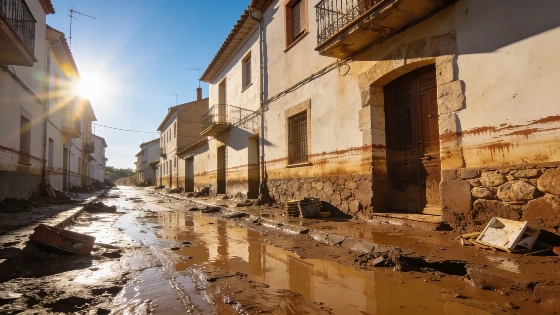
More than 230 people died in the 2024 dana, and the political response remains contested. The Spanish Government’s recovery update of 16 November 2026 recorded 242 confirmed deaths: 234 in the Valencian Community, seven in Castilla-La Mancha and one in Andalusia. It identified 78 affected municipalities across the three regions. At a meeting with victims’ associations in Catarroja, Ada Colau and fellow candidates said they wanted the Congress inquiry into the disaster reopened when the legislature began.
Colau, a Frente Amplio candidate, pledged support for the victims and their demands. She called for justice and reparation, and for an end to what she described as institutional mistreatment by PP and Vox. In remarks translated from Spanish, she said a tragedy like this must not happen again. The government’s recovery update reported that, by 16 November 2026, 396,848 grants and subsidies had been awarded to affected people and entities, with €8,293,568,794 paid.
The demand for answers also concerns Carlos Mazón, the former regional president. Águeda Micó and Alberto Ibáñez of Compromís-Front Valencià called for political responsibility over the disaster. Ibáñez said PP and Vox were keeping Mazón on as a member of Les Corts so he would not have to testify in court or assume political responsibility. The political dispute sits alongside separate scrutiny of public authorities, including an inquiry into strike policing.
Micó said reconstruction in the affected areas should be accompanied by measures to prepare the territory for future danas. She also called for action against property speculation. Colau linked that issue to development on flood-prone land, saying in a translated remark that speculation was devastating territories through irresponsible building. She called for bolder policies. Spain’s Order TMD/1586/2025, dated 29 December 2025, expanded municipal infrastructure reconstruction aid to include flood-prevention projects and climate-change adaptation. The Finance Ministry also allocated €273 million from the European-funded EDIL DANA plan to 95 local authorities for reconstruction and infrastructure modernisation aimed at preparing for future natural disasters.
Housing was also part of the candidates’ discussion. Ibáñez said he believed Colau would become vice-president for housing and argued that the previous legislature’s labour measures, including an increase in the minimum wage, offered a model for progress. The government reported that 67 homes had been offered to families with medium or low incomes through the State Affordable Housing programme in affected municipalities in Valencia province; all were provisionally allocated, and 31 rental contracts had been signed by 16 November 2026. Colau also promised to reform regional financing, describing the Valencian Community as among the regions treated most unfairly. She said her party would listen to Compromís representatives speaking for Valencians.
At a rally in Benetússer, a man carrying a megaphone interrupted Colau with the words “Out with the Catalanists”, translated from Spanish. The audience booed. Colau replied that the group had expressed itself and urged supporters not to be provoked. She also defended unity among left-wing parties in Valencia, where Compromís-Front Valencià brought together Compromís, Podemos, Izquierda Unida and Izquierda Republicana del País Valenciano.
Colau defended the amnesty as a democratically approved measure that could return political questions to political debate and end their judicialisation. On violence against women, she said in a translated statement that the only acceptable number of victims was zero. The Government of Spain’s recovery update also reported that the European Commission had approved €946 million for Spain from the EU Solidarity Fund to help mitigate the effects of the dana. Separately, €1,745,310,104.41 had been paid under municipal infrastructure reconstruction aid, with applications registered from 78 affected municipalities.