Volkswagen has launched the ID. Aura T6, an electric SUV designed exclusively for China. The model revives the T6 name, long associated with the iconic Transporter van, but now signals a shift in strategy and design for the brand’s electric lineup.
The T6 badge has always meant one thing at Volkswagen: the legendary Transporter van, a staple for professionals and camper enthusiasts alike. Now, the German automaker has taken a bold step by attaching the T6 name to a vehicle that could not be further from its utilitarian roots—the new Volkswagen ID. Aura T6, an electric SUV built specifically for the Chinese market.
Unlike the classic van, the ID. Aura T6 is a five-seat SUV, marking a clear departure from the Transporter lineage. The full name, Volkswagen ID. Aura T6, places it firmly within the brand’s electric ID. family, but the choice of badge has raised eyebrows, especially in Europe, where T6 remains synonymous with the van range. This time, however, the T6 moniker identifies the first SUV in the new ID. Aura series, a product line developed by FAW-Volkswagen as part of a broader push for China-specific models.
The vehicle first appeared as a prototype at the Beijing Auto Show, but its final design and technical details have now emerged through Chinese regulatory filings. Measuring 4.81 meters long, 1.88 meters wide, and 1.65 meters high, the ID. Aura T6 slots between the existing ID.4 and ID.6 SUVs sold in China. It is just 65 millimeters shorter than the ID.6, but unlike its larger sibling, it forgoes a third row of seats to focus on comfort and space for five occupants.
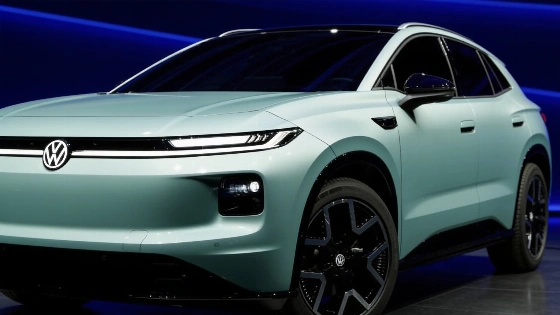
Visually, the ID. Aura T6 introduces a new design language for Volkswagen’s Chinese lineup. The front features a continuous light strip across the width of the car, with main headlights integrated into the bumper. Semi-concealed door handles, a rear light bar, and more muscular proportions set it apart from the European ID. models.
One standout feature is the roof-mounted LiDAR sensor, a first for a FAW-developed Volkswagen electric SUV. This advanced sensor, part of the Carizon platform developed with Horizon Robotics, enables sophisticated driver assistance functions for both highway and urban driving. The model also benefits from the new CEA electronic architecture, created in partnership with Xpeng, which aims to accelerate software and assistance system development—a field where Chinese brands have gained ground over traditional automakers.
Under the hood, the ID. Aura T6 will initially be offered with a single rear-mounted electric motor producing 170 kW (228 hp), allowing a top speed of 186 km/h—outperforming the current ID.6 in China. Power comes from an LFP battery supplied by Gotion, though Volkswagen has yet to confirm its capacity. The presence of two different homologated weights suggests at least two versions with varying range.
Volkswagen’s strategy is not to replace the ID.6 with the ID. Aura T6, but to position it between the ID.4 and ID.6, offering a longer body than the ID.4 but sticking to two rows of seats for greater interior and boot space. For now, there are no plans to export the model beyond China, meaning the unconventional use of the T6 name will remain a local phenomenon.
This move reflects a broader trend of global carmakers adapting their lineups for the Chinese market, where competition is fierce and consumer expectations are rapidly evolving. As seen with other electric SUVs making waves in the region, such as the Leapmotor B10, which recently became Spain’s best-selling electric car (read more about the Leapmotor B10’s impact here), the landscape for electric vehicles is shifting quickly.
For context, the ID. Aura T6’s debut underscores how legacy brands are rethinking both design and branding to stay relevant in China’s dynamic automotive sector. The use of the T6 name on an SUV may be jarring for European fans, but it signals Volkswagen’s willingness to experiment as it navigates the world’s largest car market.