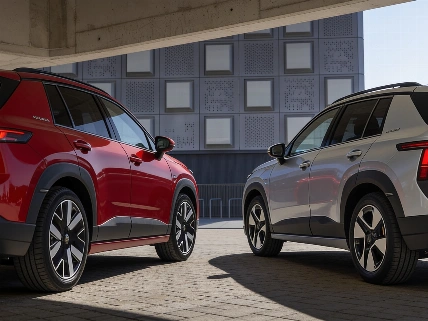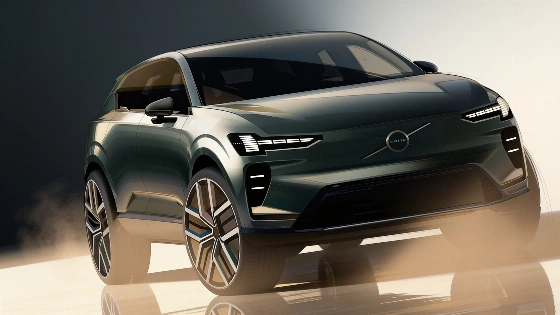
Volvo is preparing to expand its electric lineup with a lower-priced battery-electric SUV expected to sit between the EX40 and EX60. The project is widely identified as the EX50, although Volvo has not officially confirmed that name. Volvo has described the vehicle as a “global battery-electric vehicle targeting the large and more affordable segment in Europe.” If launched under that badge, it would be the second Volvo model based on the SPA3 electric architecture, following the EX60.
EX50 specifications remain projections. Reports have suggested 80-kWh and 91-kWh battery options, a range of 620 to 660 kilometers and DC fast charging of up to 320 kW, but these figures have not been established as final production specifications. The EX60 offers a reference for technology Volvo could adapt: reported usable battery capacities are 80, 91 and 112 kWh, with claimed range of up to 810 kilometers depending on configuration. Its 800-volt system supports charging at up to 320 kW in rear-wheel-lead versions and 370 kW in all-wheel-lead versions. A 10% to 80% charge is reported to take about 16 minutes under the fastest conditions. Those are EX60 figures, not confirmed EX50 capabilities. The EX60’s reported U.S. starting prices range from $58,400 for the rear-wheel-lead P6 Plus to $65,000 for the P6 Ultra, showing the price space a more affordable SPA3 model could occupy. Coverage has put the EX50’s prospective starting price below $50,000.
The EX50 is expected to offer more accessible power levels than the EX60, whose reported powertrain range reaches up to 680 hp. Its design is rumored to draw on the EX60, including Volvo’s signature “Hammer Head” headlights, a closed grille and a streamlined rear with vertical taillights. Inside, it is expected to follow Volvo’s minimalist approach, with a two-spoke steering wheel, a compact digital instrument cluster and a large central touchscreen for multimedia and vehicle controls.
With a projected length of 4.5 to 4.6 meters, the EX50 is expected to target the compact SUV segment (C-SUV), with seating for five and a generous cargo area. It would compete with models such as the Mercedes GLA, BMW iX1 and Audi Q4 e-tron, while broadening Volvo’s electric range between the smaller EX40 and the larger, more expensive EX60. Reports also suggest it will be longer and taller than the current EX40.
Volvo has filed an EX50 trademark application with the European Union Intellectual Property Office. The filing marks a regulatory step in the naming process, but does not establish the production model’s final badge or technical specifications. Volvo’s planned electric-vehicle facility near Košice, Slovakia, is associated with the program; the plant is projected to have annual capacity of up to 250,000 vehicles. Industry reports link manufacturing to around 2027, while Volvo has scheduled first customer deliveries of the forthcoming vehicle for after summer 2027. European production would support regional manufacturing and supply-chain integration. Other brands are following local-production strategies, including the assembly of the Leapmotor B10 (see how local production is reshaping the EV market).
The XC40 is expected to remain in Volvo’s lineup after the EX50 arrives. The company is also working on a impressive XC40 update, bringing its design and technology closer to those of the latest XC60. The XC40 will continue to be offered as a mild hybrid, plug-in hybrid and fully electric model, including the EX40 and EC40 derivatives.
Volvo’s strategy reflects a broader industry shift toward electrification and European-based production as manufacturers seek to balance technology with affordability and regional manufacturing. With the EX60 already attracting more than 50,000 European orders, the SPA3 platform is basic to the company’s next electric-vehicle rollout. The EX50 is expected to strengthen Volvo’s position in the competitive electric SUV market and offer Spanish and European buyers another option in the coming years.