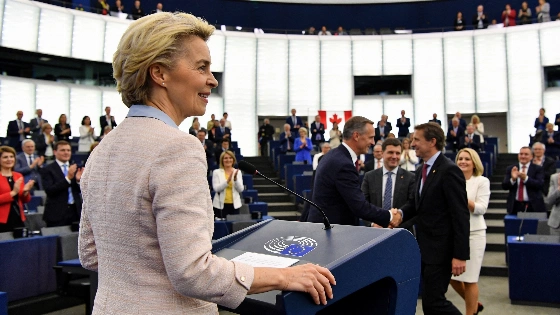
Ursula von der Leyen has suggested making Canada the first associate member of the EU. The move sparked immediate threats of tariffs from Donald Trump. The proposal signals a new phase in transatlantic relations.
Ursula von der Leyen has stirred debate in Brussels by proposing that Canada become the first associate member of the European Union. She made the announcement in Strasbourg, where European lawmakers gave her a standing ovation and Canadian Prime Minister Mark Carney, who attended the State of the Union address, received an embrace from von der Leyen.
The proposal, made public on September 16, 2026, is the first time the European Commission has openly floated the idea of an "associate member" status for any country, according to NPR and Reuters. Von der Leyen spoke about shared values and strategic interests between the EU and Canada, but did not lay out any legal or institutional details. The term "associate member" does not exist in current EU treaties.
Reuters notes that the term 'associate member' is not defined in EU law, and von der Leyen did not propose amending the founding treaties to create such a status.
The timing comes as the EU looks to strengthen alliances in what von der Leyen called the "cold fragility" of the current world order. She did not specify what associate membership would involve, but pointed to common ground with Canada on artificial intelligence, climate policy, Ukraine, defense, and supply chains. BBC and Reuters report that the idea is seen as a response to global instability and the need for dependable partners.
Von der Leyen also mentioned the possibility of a European Security Council that could include Canada, the United Kingdom, and Norway. This reflects concerns in Brussels about hybrid attacks on Europe’s eastern borders since Russia’s invasion of Ukraine in 2022, which has kept both NATO and the EU alert. Bringing non-EU partners into such a council would mark a shift in how the bloc approaches security cooperation.
The US response was swift and hostile. Speaking in North Carolina, Donald Trump threatened heavy tariffs on Europe or even a halt to trade if Canada is given special EU status. He called the move an "act of hostility" and promised "serious tariffs" in response. According to Reuters, the Trump administration warned that granting Canada a unique status could spark a transatlantic trade conflict, with the US threatening measures against both the EU and Canada.
Interest in a closer partnership with the EU has come from both Brussels and Ottawa. Mark Carney has publicly denied any intention for Canada to seek full EU membership, instead advocating for a 'unique alliance' that would not require treaty changes. Previous discussions in the EU about similar statuses, such as for Ukraine, have also faced institutional resistance and would likely take years to implement.
Mark Carney welcomed the proposal, calling it a chance for a deeper partnership. He argued that Canada and Europe need to secure their strategic autonomy through broad cooperation. Still, the EU has often resisted flexible alliances without legal status, and earlier suggestions—like Germany’s idea for Ukraine to become an associate member—have met with little enthusiasm from member states. As Euronews reported, German politician Friedrich Merz suggested a similar arrangement for Ukraine in 2026, involving participation in summits and programs but without voting rights.
Von der Leyen’s statement that "Europe and Canada believe in democracy" highlights the political message behind the proposal. But with no details on what associate membership would mean, many questions remain. The EU has traditionally been cautious about new forms of partnership outside its legal framework. BBC and Reuters note that creating such a status would require complex decisions and could take years.
For Spain and other EU countries, the idea of Canada joining as an associate member could reshape the bloc’s external relations and security structure. A European Security Council with non-EU partners signals a willingness to adapt to new threats and alliances, but also risks provoking trade conflicts with the United States, as Trump’s reaction shows.
In the broader context, the EU’s move to deepen ties with Canada reflects a strategic shift in response to global instability and the war in Ukraine. The proposal shows the bloc is looking for reliable partners who share its values and interests, especially as transatlantic relations face new strains. While the details of associate membership are still unclear, the political message is direct: Europe is rethinking its alliances and security arrangements. The sharp US response suggests that any change in the EU’s external partnerships will face pushback, and the coming months may test both European unity and transatlantic cooperation.