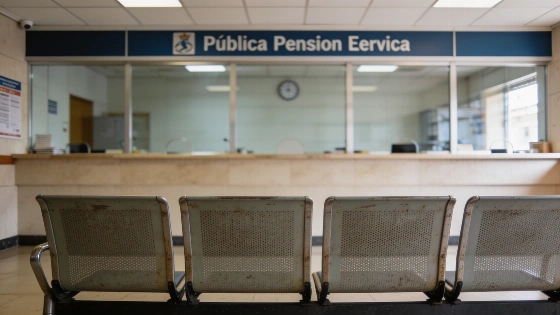
More than 10 million voters in Spain are over 65, a group Santiago Abascal has sought to reassure as Vox’s pension proposals remain short on practical detail. He has said pensions would continue to be paid under a Vox government, but has not explained how its proposed system would work. Spain’s pension reserve fund reached €66.815 billion in nominal terms in 2011, or €72.7 billion in 2021 euros. Withdrawals to finance pension payments began in 2012. By 2019, the fund had fallen to slightly more than €2 billion, according to figures reported from the Fundación de Estudios de Economía Aplicada (Fedea).
The distinction matters: keeping pension payments going does not settle how they would be uprated. Asked by Carlos Herrera on La Cope what Vox’s programme said about pension increases, Abascal argued that Pedro Sánchez’s continuation as prime minister would put payments at risk. He did not say whether Vox would raise pensions in line with the consumer price index (IPC). Spain’s 2021 pension reform linked annual increases to the IPC and removed the previous sustainability factor. Vox and the Partido Popular voted against the measure.
José María Figaredo gave a clearer answer at a debate organised by La Sexta, when journalist Ana Pastor pressed him on index-linked increases: he said Vox would do so. At a campaign debate reported on 14 November 2026, Figaredo also said Vox would maintain increases in line with the IPC if it governed. Pablo Bustinduy, a minister from Frente Amplio, replied that Vox had consistently voted against pension revaluation in Congress. Figaredo said mass immigration had made pensions unsustainable under the government’s management.
The party’s position on revaluation has also faced scrutiny in Madrid’s regional assembly. On 12 November 2026, the assembly approved two non-legislative initiatives supporting the public pension system and IPC-linked increases. Vox was the only parliamentary group to vote against both, while the Partido Popular supported them after its proposed amendments were rejected. At national level, Spain’s Independent Authority for Fiscal Responsibility (AIReF) projects gross public pension spending to rise from 13% of GDP in 2025 to 16.4% in 2050.
That exchange sits uneasily beside the party’s long-standing support for a fundamental redesign. Vox’s 2018 declaration of principles proposed a mixed system combining capitalisation with pay-as-you-go funding. Its economic programme, approved in June 2025, called for beginning to capitalise a public pension fund using private-sector return criteria, then moving towards a mixed model similar to Sweden’s. Fedea has described pension sustainability as a challenge even amid record employment and improved contribution revenues.
Under the Swedish arrangement described in the programme, 2.5% of gross salary goes into a private pension fund and 16% into a national account used to calculate future pensions. The calculation takes account of life expectancy and average wage growth, while also factoring in the system’s sustainability.
Vox’s 2019 election programme set out more detail on the transition. People under 25 and new contributors would put half their contributions into private Pension Fund Administrators (AFP), regulated by the state. Those aged 25 to 45 could choose between systems; people over 45 would stay in the existing pay-as-you-go system, which the programme envisaged phasing out over several decades. Abascal has not confirmed whether that transition plan still stands.
Figaredo made the case for capitalisation in an interview with blogger Víctor Domínguez of Wall Street Wolverine. Based on a salary of €19,000 a year and pension contributions of more than €5,000 annually, he estimated that investing contributions for 40 working years could produce a fund exceeding €500,000. He said someone living to 85 could draw more than €2,000 a month and leave €200,000 to an heir. Those figures illustrated a pure capitalisation system, not a guaranteed pension outcome.
His calculation relied on returns from the S&P 500. The index lost 14% over the decade from 2000 to 2010, excluding dividends. Figaredo also said part of the system would need to remain pay-as-you-go so the state could support people with low incomes or those unable to contribute because of circumstances such as disability. In a 2025 interview with Domínguez, he described the transition as “traumatic,” translated from Spanish.
Abascal has also directed questions about the technical design to Figaredo. The PNV has separately ruled out any pact involving Vox, as detailed in an earlier report.