Whether drivers must display the DGT environmental sticker on their car’s windshield depends on the rules of the municipality they are visiting: Spain has no nationwide rule requiring every vehicle to display it everywhere. Drivers should check access conditions for each destination, because penalties can apply if a vehicle enters a restricted area in breach of local rules.
The Dirección General de Tráfico (DGT) assigns vehicles environmental categories based on factors such as fuel type and emissions standards. Its basic labels are “0 emisiones,” “ECO,” “C” and “B”; vehicles that do not meet the relevant criteria remain unclassified. Public authorities use these categories to manage traffic and pollution, but they are not a nationwide driving permit. A label does not, by itself, guarantee access to every Low Emission Zone, or Zona de Bajas Emisiones (ZBE).
Spain’s Climate Change and Energy Transition Law, Law 7/2021 of 20 May, requires municipalities with more than 50,000 inhabitants, island territories and certain other population centres to establish low-emission zones. Royal Decree 1052/2022, dated 27 December, sets the national structure for designing and implementing ZBEs, as well as evaluating them. Local authorities set the specific restrictions and exemptions, along with the controls used to enforce them, so requirements can differ between cities.
Local regulations and fines
Madrid shows how local rules work. Its ZBE restrictions include citywide measures and more restrictive areas, such as Distrito Centro and areas around Plaza Elíptica. The city uses vehicle-registration information and camera systems for enforcement, so authorities may identify a vehicle without relying solely on its physical sticker. Certain violations of Madrid’s access rules carry a standard fine of €200, which may be reduced to €100 under the applicable prompt-payment procedure. The fine is for breaching the rules, not simply for lacking a sticker, and other municipalities may set different restrictions and penalties.
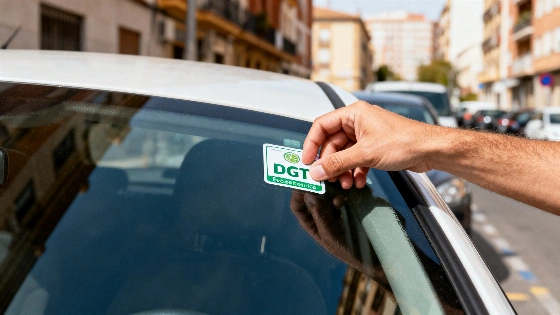
The DGT environmental badge commonly costs €5 and is available through Correos branches and other authorised distribution channels. It is normally placed in the lower-right corner of the front windscreen, viewed from inside, so it can be seen from outside. Motorcycles and other vehicles without a windscreen should display it somewhere clearly visible. The sticker identifies the vehicle’s classification; buying or displaying one does not automatically grant permission to enter a restricted zone.
What drivers need to know
Before travelling, check the destination municipality’s current ZBE map, access rules and exemptions, and confirm the vehicle’s DGT category. A driver crossing several municipalities may face different restrictions along the same journey. Where local requirements or enforcement practices make the badge relevant, display it in the prescribed position.
Spain’s low-emission-zone structure applies across many urban areas, but implementation varies: cities set their own boundaries and vehicle restrictions, along with timetables, exemptions and enforcement methods. As more municipalities establish or update ZBEs, drivers should follow changes to local rules rather than assume that one sticker requirement or access rule applies throughout the country.