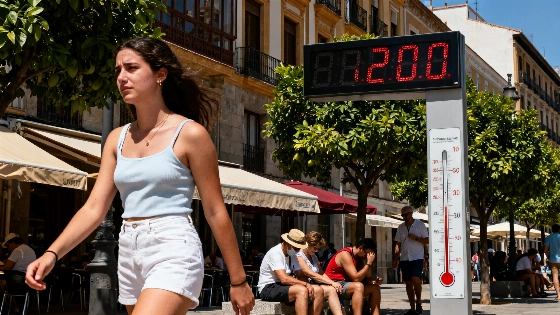
Anomalous Heat in Spain: Temperature Records and Sleepless Nights. Spain is experiencing a heatwave with temperatures reaching up to 38 degrees. Unusually high values are being recorded even in the north of the country. Meteorologists warn that the heat will persist at least until the middle of next week.
Spain is experiencing unusually hot weather for May: in several regions, temperatures have already exceeded levels typical for midsummer. According to the Agencia Estatal de Meteorología (Aemet), the heat will persist in the coming days, and new temperature records are possible in some cities.
On Thursday, thermometers in Badajoz reached 38 degrees, while Seville recorded 37. Unusually high readings were also reported in the north: in Oviedo and Bilbao, temperatures exceeded 34 degrees. However, meteorologists note that despite the intensity and duration, this period will not be officially classified as a heatwave, since the values match July and August averages but do not surpass them according to Aemet criteria.
Over the next few days, northwestern regions, including Galicia and Asturias, are expected to see strong storms, possibly with hail. On Saturday, precipitation may spread to Cantabria and the northwest of Castile and León. A noticeable drop in temperature is forecast in these areas—by up to 8 degrees compared to the previous day. Nevertheless, even after the temperature decreases, Oviedo is expected to see around 26 degrees, and Bilbao up to 30.
In Navarre, partly cloudy skies will persist on Saturday, with fog and low clouds possible at night in the western part of the region. Significant temperature changes are not expected, except for a slight increase in nighttime lows in the Ebro valley and on Pyrenean summits, and a decrease in daytime highs in the north. Winds will be light, shifting to a northerly direction in the afternoon.
In the rest of the country, the heat will persist: in the central and southern regions, as well as in the Ebro, Guadiana, and Guadalquivir valleys, daytime temperatures will rise above 34–36 degrees. On Saturday night, so-called tropical nights are possible in the center, south, and Ebro valley, when temperatures do not drop below 20 degrees. On Sunday, the heat will intensify again: up to 32 degrees is expected in Bilbao, 33 in Madrid, 34 in Ourense, 36 in Zaragoza, and 38 in Badajoz.
On Sunday, thunderstorms will again affect Galicia and Asturias, as well as some mountainous areas in the north and center of the country, including the Iberian System and the Pyrenees. At the beginning of next week, according to Aemet, the heat will persist across almost all of Spain, while the thunderstorms will gradually weaken. Meteorologists do not rule out that by midweek the heat may intensify.
The Canary Islands will also see temperatures rise starting Saturday: in certain areas of Gran Canaria, Lanzarote, and Fuerteventura, the air will heat up above 34 degrees, and nighttime lows will exceed 22 degrees. The archipelago as a whole will remain mostly clear, with the possibility of a dusty haze (calima). By midweek, temperatures on the islands are expected to drop and return to the usual May levels.
According to Aemet, May 2026 could be among the hottest in recent decades. In Spain, such temperature anomalies at the end of spring are becoming increasingly common: statistics show that over the past 20 years, average May temperatures have risen by almost 1.5 degrees. Early heat increases the load on the energy system and poses greater health risks for vulnerable population groups.