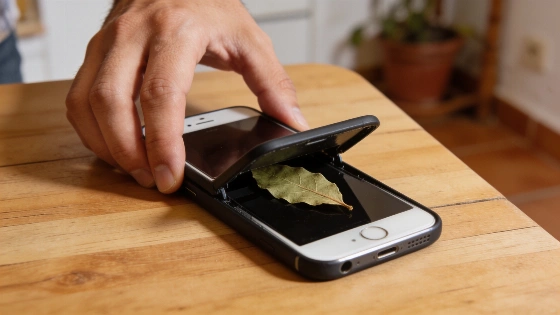
In recent months, a curious trend has taken hold: people are tucking dried bay leaves between their mobile phones and cases, hoping the leaves will bring good fortune or shield them from negativity. The ritual, which has gained traction through social media and lifestyle blogs, draws on the symbolic power long attributed to the laurel plant. Its real impact, though, is more nuanced than the promises suggest.
The bay leaf, or Laurus nobilis, is a Mediterranean evergreen in the laurel family, Lauraceae. Its history reaches back to ancient Greek and Roman traditions: laurel was associated with Apollo, and crowns made from its leaves marked achievement at Delphi’s Pythian Games, where athletes competed and achievement in music and poetry was recognized. Roman culture also linked laurel with military triumph and public honor. Over time, the symbolism extended to scholarship and literary achievement, surviving in words such as “laureate.” A leaf kept in a phone case shifts that once-public emblem of distinction into a private, everyday ritual.
Folk customs have also treated laurel as a talisman: leaves were carried in pockets or hung near doorways for protection. The phone case offers a contemporary way to keep the symbol close, but the historical record centers on crowns and household customs. It also documents culinary use, not a specific ancient practice involving phones or a traditional Feng Shui rule.
Symbolism Over Science
There is no scientific evidence that a bay leaf can change a person’s fortunes, whether by attracting wealth or job offers or by warding off bad luck. The belief is largely symbolic, drawing on centuries-old traditions rather than demonstrated effects. Laurus nobilis is used as a seasoning, and its naturally occurring aromatic compounds account for its characteristic smell. They provide no known mechanism for influencing fortune or external events.
Some online sources link the trend to Feng Shui, but the documented history of laurel points instead to Greek and Roman religious culture, public honors, household folklore and cooking. Placing a leaf in a phone case is best understood as a modern adaptation of older associations with achievement and protection, rather than an established classical custom.
Bay laurel can also be confused with ornamental plants that have similar-looking leaves. Only the edible species, Laurus nobilis, is used as a culinary bay leaf; the lookalikes should not be treated as interchangeable.
Psychological Effects and Rituals
While no studies have tested the specific act of carrying a bay leaf in a phone case, broader research into ritualized behavior suggests that such actions can offer modest psychological benefits. A 2022 study in Scientific Reports, for example, found that ritualized activities slightly reduced anxiety among participants facing stressful situations, though the effect was limited. Rituals may help people feel more in control, but they do not alter external circumstances.
Some widely cited studies on rituals and performance have been formally retracted, a reason for caution when interpreting claims about their effectiveness. Carrying a bay leaf may work as a personal reminder or motivator, much like a note or photo, if the individual assigns it meaning.
Practical Use and Limitations
For those who choose to adopt the habit, the bay leaf’s value lies in its role as a symbolic prompt. Writing a specific, actionable goal, such as “review my expenses” or “apply for three jobs,” can turn the leaf into a daily nudge toward real-world action. Any results, but, depend on the person’s decisions and effort, not on the leaf itself.
To avoid mess, the leaf should be dry and intact; if it breaks or deteriorates, it’s best to remove it. There is no need for rituals of “activation” or replacement on a set date. These are matters of belief, not science.
The bay leaf in a phone case is a modern twist on an old symbol. It may help some people focus on their intentions, but it offers no guarantee of prosperity or protection. Other viral lifestyle hacks have drawn similar scrutiny: experts have also questioned the much-discussed use of aluminum foil in washing machines (see this analysis). In both cases, the real effect is often psychological, not magical.