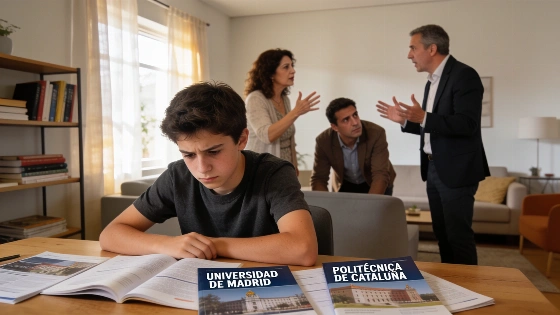
Thousands of Spanish teenagers face intense pressure when selecting a university degree after Selectividad. Family expectations, job market fears and limited career guidance often push students into fields that don’t match their interests, leading to high dropout and degree-switch rates.
At 17, Spanish students are expected to make a decision that can define their adult lives: what to study at university. For many, this choice is less about personal passion and more about navigating family expectations, social stigma, and the realities of the job market. According to the Ministry of Science, Innovation and Universities, 22.1% of first-year university students in the 2021-2022 academic year abandoned their initial degree after just one year—a figure that highlights the scale of the problem.
Many students admit that their university choice was shaped by external pressures rather than genuine interest. The fear of limited job opportunities in certain fields, especially the humanities, and a lack of meaningful career guidance often push young people toward degrees that don’t fit their strengths or aspirations. Disillusionment frequently sets in during the first months of university, as students realize the mismatch between their studies and their true interests.
Switching Degrees: A Common Reality
Official data shows that 9% of students change their degree after the first year, while 13.1% leave the Spanish university system altogether. Personal stories illustrate how these decisions unfold. María Domínguez initially enrolled in Chemistry, believing it would be easier, but soon discovered through a biology class that the content didn’t resonate with her. She switched to Physics, where she finally found a sense of purpose. Manuel Doval left Architecture despite passing his courses, feeling that the field simply wasn’t right for him. After moving to Physics, he felt confident he had made the right call.
The Weight of Stigma and Expectations
For students like Ana Osle, the stigma attached to humanities degrees is hard to ignore. Although she was drawn to the arts, she chose Industrial Engineering because she excelled in science and math. “How could I paint when I could study Mathematics?” she recalls thinking. After struggling and failing courses, she transferred to English Studies at the Complutense University of Madrid, where she found a better fit. Natàlia Bohórquez also started in Industrial Engineering, influenced by the belief that it would guarantee employment, but later switched to Journalism. In hindsight, she says she would return to engineering, acknowledging that changing degrees does not always resolve underlying uncertainty.
Statistics reveal that degree changes are most common in Sciences (12.4%) and Engineering and Architecture (10.8%), with Social Sciences at 8.1% and Arts and Humanities at 9%. These numbers reflect the ongoing tension between personal interests and perceived job security.
Guidance Gaps and the Role of Grades
Many students report receiving little to no professional guidance before enrolling. Recommendations were often based solely on high school grades: those strong in math were steered toward engineering, with little attention paid to their broader interests or career goals. Ana Cobos, president of the Confederation of Organizations for Psychopedagogy and Guidance in Spain, argues that effective counseling should connect personal strengths and aspirations with academic options and labor market realities, rather than simply listing degrees and job prospects.
Changing Course Without Shame
Family reactions can add another layer of stress. Manuel Doval remembers his parents’ initial disappointment when he switched degrees, though they eventually supported his decision. Others found their families more understanding from the start, which helped ease feelings of guilt or failure. Cobos emphasizes that leaving a degree that doesn’t fit is not a defeat, but a necessary step to avoid years spent pursuing the wrong path. While changing courses can bring frustration and academic costs, it can also prevent deeper dissatisfaction later on.
The challenge of balancing family expectations and personal ambition is not unique to university students. In other fields, such as aviation, family legacy and career choices often intersect, as seen in the story of a Vueling captain and his daughter who both became pilots—a dynamic explored in this look at generational career decisions.
As Spain continues to debate how best to support young people at this critical crossroads, the data suggests that more nuanced guidance and a broader acceptance of diverse career paths could help reduce the high rates of degree changes and dropouts. For now, the decision of what to study at 17 remains one of the most complex—and consequential—choices Spanish families face.