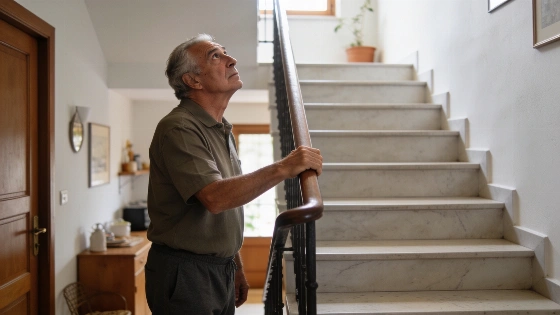
Many Spaniards over 70 can walk long distances but struggle with stairs at home. Professor Felipe Isidro reveals how age-related muscle changes make stair climbing a unique challenge, and why walking alone is not enough to maintain full mobility.
Felipe Isidro, Professor of Physical Exercise and Health, has drawn attention to a problem familiar to many Spanish households: people over 70 who can walk comfortably on flat ground but find themselves unable to climb the stairs in their own homes. His analysis, widely shared on social media, highlights a gap in how we understand aging and mobility.
According to Isidro, the root of this issue lies in the early loss of fast-twitch muscle fibers. These fibers are essential for generating quick, powerful bursts of force—precisely what is needed to lift the body up each step. While walking on level surfaces relies on slow-twitch fibers and steady, continuous effort, stairs demand a sudden, concentrated push from a single leg, often while the knee is bent at a sharp angle.
Different Demands
Walking on flat ground is a rhythmic, horizontal movement that most older adults can maintain for long periods. It requires balance and endurance but does not test the body's ability to generate explosive force. This is why many seniors remain active walkers yet struggle with tasks that require more strength, such as climbing stairs or rising from a low chair.
Stair climbing, by contrast, is a vertical challenge. Each step forces the body to lift its full weight, often placing three to four times the person's body weight on a single leg. The movement is brief but intense, and any loss of muscle mass or joint flexibility quickly becomes apparent. For some, this means pain, breathlessness, or the need to pause after just a few steps.
Muscle Loss and Aging
Isidro points to sarcopenia—the age-related loss of muscle mass—as a key factor. Fast-twitch fibers, which are responsible for rapid, forceful movements, tend to decline earlier and more sharply than slow-twitch fibers. As a result, older adults may retain the ability to walk but lose the strength needed for more demanding actions. Bone density loss and increased arterial stiffness can further limit mobility.
This mismatch explains why walking is not a complete measure of functional strength. Someone who appears fit while strolling may still face significant barriers at home, especially in buildings with multiple flights of stairs or where daily routines require frequent climbing.
What Can Help
To address this, Isidro recommends a three-pronged approach: targeted muscle strengthening, improved stair-climbing technique, and adapting the home environment. Strength training can help rebuild lost muscle fibers, while learning safer movement patterns reduces strain on joints. Home modifications—such as installing handrails or reducing the number of steps—can make a significant difference for those with limited strength.
However, Isidro notes that simply walking more is not enough. The specific demands of stair climbing require focused exercises and, in some cases, changes to the living space. While not every person over 70 will experience these difficulties, the ability to walk does not guarantee the strength needed for all daily activities.
Context and Practical Advice
Spain's aging population and prevalence of multi-story homes make this issue especially relevant. According to recent data, more than 20% of Spaniards are now over 65, and many live in buildings without elevators. National guidelines increasingly emphasize the importance of strength training for older adults, not just aerobic activity. For families and caregivers, recognizing the difference between walking ability and true functional strength is key to supporting independence at home.