Those massive concrete spheres lining Spanish sidewalks are not just urban decoration. Their real purpose is to shield pedestrians, enforce accessibility, and prevent vehicles from invading spaces meant for people. Here is why their presence is far more critical than most realize.
Concrete spheres along Spanish sidewalks are easy to overlook or mistake for public seating, but they serve a much more serious purpose. These heavy barriers are designed to keep vehicles off the pavement and protect people walking by, especially in busy areas.
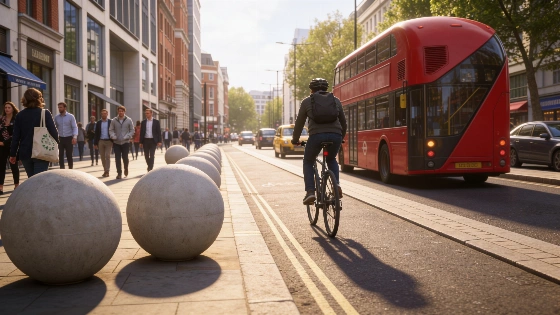
Each sphere is placed with intention. Their weight and rounded shape make it nearly impossible for cars, vans, or even buses to drive over the curb, particularly at intersections, near schools, hospitals, and transit stops. The idea is simple: a vehicle can't cross what it can't move. These barriers are often the last line of defense when a driver loses control or ignores the rules. Recent coverage in Spanish media points out that these spheres are now seen as essential for keeping vehicles out of pedestrian zones, especially where foot traffic is heavy or people are more at risk.
A recent technical review notes that concrete spheres are typically installed with a setback of 0.30–0.50 meters from the curb, and the gap between them should not exceed 1.50 meters to prevent vehicle passage.
But their job isn't just to stop cars. They're also positioned to keep sidewalks accessible for wheelchair users, people with strollers, and anyone with limited mobility. By flanking ramps and crossings, the spheres make sure these access points stay clear of parked vehicles. Without them, drivers often block ramps, forcing people into the street. Several Spanish publications from September 2026 highlight that protecting ramps and keeping sidewalks open are now seen as the main reasons for these barriers, not just as a design choice.
They also help protect the city's infrastructure. Delivery trucks and buses, which sometimes cut corners, can't damage curbs or sidewalks when these spheres are in place. This means less repair work and a clearer boundary between spaces for vehicles and for people. Municipal guidelines stress that these barriers help prevent both injuries and damage to the city itself.
In 2026, Spain reinforced its commitment to accessible urban spaces with a new royal decree on cognitive accessibility, requiring that public environments be easier to navigate and understand for all users. These regulations, which take effect on January 2, 2027, specifically highlight the importance of elements like bollards and concrete spheres in ensuring both safety and accessibility.
Known as bolardos, these spheres have roots in maritime history. The word comes from the French term for the posts used to tie up ships at docks. As cities grew, the idea moved from the port to the street, becoming a tool for keeping order and protecting people. Today, their placement follows strict rules meant to balance the needs of drivers, cyclists, and pedestrians. Spanish regulations and expert commentary now link "bolardo" mainly with urban safety, not its nautical past.
Their shape is also intentional. Spheres have no sharp edges, so if someone bumps into one—at night or in a crowd—they're less likely to get hurt. Concrete is used because it's dense and tough, making it almost impossible for a vehicle to move or break the barrier without a lot of force.
Some people debate whether these spheres take up too much space or look out of place, especially on narrow sidewalks. But their purpose isn't up for discussion. As city traffic gets busier and the push for walkable, accessible streets grows, the need for these simple, sturdy barriers is only more obvious. Spanish officials and planners keep pointing out how important they are for stopping illegal parking on sidewalks, a problem in crowded neighborhoods and near shops.
What looks like a plain ball of concrete is actually a quiet protector of city life. It's there because pedestrians face real risks every day, and because city design is about making sure people can move safely and freely. The next time you see one, remember: it's not just for show. It's there to make sure the city puts people first.