After two decades in construction, Francisco José González García—known as Fran—traded his stable job for the uncertain world of beekeeping. Now, he manages 400 hives across three provinces, producing and selling natural honey under the Mielegante brand. His story reveals both the challenges and rewards of rural self-employment in Spain.
In February 2020, Francisco José González García made a decision that would reshape his life. After 20 years as a construction site manager, Fran walked away from the security of his profession to dedicate himself fully to beekeeping—a path rooted in his childhood summers spent in Torrelobatón, Valladolid, surrounded by fields and animals.
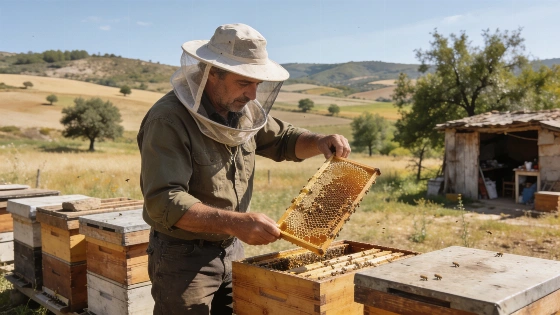
Today, Fran oversees around 400 beehives spread across Valladolid, Zamora, and Palencia. Operating under the brand Mielegante, he handles every stage of production himself: tending the bees, harvesting the honey, and packaging it in his own workshop in Torrelobatón. The honey, sold in jars priced between 10 and 12 euros, reaches customers through direct sales and a network of about 20 small retailers.
Building a Rural Business
Fran’s operation consists of roughly 15 apiaries, with two located in Torrelobatón and the rest scattered throughout the region. He personally travels between sites, collects the honey, and processes it in his facility, which includes dedicated spaces for extraction, bottling, labeling, and storage. The entire business is a one-man effort, reflecting a model of rural self-employment that has become increasingly rare in Spain.
Mielegante offers several varieties, including flower, lavender, chestnut, and heather honey. Occasionally, Fran produces small batches of whipped honey and honeycomb, as well as a honey liqueur made by blending orujo with his own product. Each variety comes with its own production challenges and costs, with heather honey, for example, requiring more resources than standard flower honey.
High Costs, Tight Margins
Despite the appeal of natural, locally produced honey, Fran’s business faces significant financial pressures. The price per jar varies depending on the variety and the expenses involved, but margins remain slim. As the sole worker, Fran must cover all costs himself: fuel for traveling between apiaries, maintenance of his workshop, jars, labels, hive upkeep, and specialized equipment for breeding new colonies.
While the business allows him to make a living—"enough to eat and enjoy a few small luxuries," as he puts it—the reality is that profitability is limited. The situation is emblematic of many rural ventures in Spain, where the freedom of self-employment often comes at the expense of financial security.
Uncertain Future for Beekeeping
Beyond economic challenges, Fran faces risks that are largely out of his control. Weather patterns, especially spring and summer rainfall, directly impact honey yields. The loss of hives and fluctuating market prices add further uncertainty. But perhaps the greatest threat is generational: Fran worries that few young people are willing to take on the demanding, low-margin work of beekeeping. Without new entrants, he fears the profession could disappear from the Spanish countryside.
Despite these concerns, Fran remains committed. For him, beekeeping is both a livelihood and a passion—a way to stay connected to the land and to a tradition that shaped his early years. As rural Spain continues to change, stories like Fran’s highlight both the resilience and the fragility of small-scale agriculture.