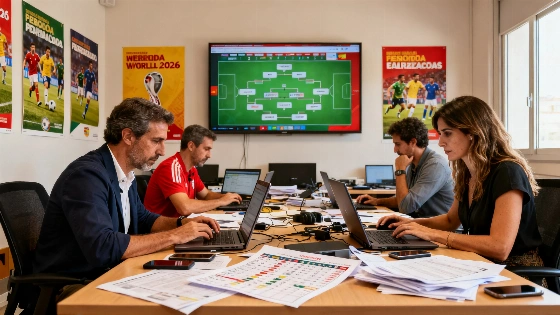
Spanish forecast for WC-2026: how the MARCA model works. MARCA has introduced its own predictor for the 2026 World Cup. The model calculates the odds of 48 national teams advancing through each stage of the tournament. At its core is the Elo system, which takes into account the current form of the teams.
Ahead of the 2026 FIFA World Cup, the Spanish outlet MARCA has launched an updated predictor that assesses the chances of all 48 national teams at each stage of the tournament. Unlike the standard FIFA ranking, this tool uses the Elo system—a mathematical method that more accurately reflects the true strength of teams and their current form.
The Elo system, originally developed for chess, has long been used in football as well. Each national team receives a numerical rating that changes after every match: a victory over a strong opponent earns more points than a win against a lower-ranked team. For its calculations, MARCA uses data from eloratings.net, one of the most reputable databases for international football.
The main difference between Elo and the FIFA ranking lies in dynamism and precision. While FIFA takes into account the number of matches played and may overrate teams that frequently play weaker opponents, Elo is updated after every result and gives a better reflection of current form. According to MARCA, Elo tends to be more accurate for predictions in major tournaments.
In MARCA's predictor, the probability of victory for each match is calculated based on the difference in team ratings. If the gap between teams exceeds 400 points, the likelihood of a draw is minimal. For example, in the Spain (2155 Elo) vs. Qatar (1421 Elo) matchup, Spain’s chance of winning reaches 86–88%, while the probability of a draw is estimated at less than 6%.
A key feature of the model is daily data updates. After each match day, the ratings are recalculated automatically, and the teams' chances of advancing from the group stage, reaching the quarterfinals, semifinals, and final change depending on the latest results. The final percentages are based on 100,000 tournament simulations: for example, if Argentina wins in 15,000 of them, their probability of victory is 15%.
Unlike other approaches, MARCA emphasizes that this is not a prediction, but a probabilistic assessment: the model shows how much stronger one national team objectively is compared to another at this moment. This allows fans and analysts to track not only the progress of matches, but also how expectations shift as the tournament unfolds.
Interestingly, other European teams are also undergoing significant changes: for example, Italy has started a new cycle with a revamped squad and a new coach, which became the subject of a separate article (details about Italy's first match after the coaching change).
For reference: the Elo system is used not only in football, but also in other sports where objective assessment of opponents' strength is important. In recent years, this approach has increasingly been adopted by leading sports media and analysts. With the expanded 2026 World Cup format featuring 48 teams and new regulations, such tools have become especially relevant for evaluating teams' real chances of success.