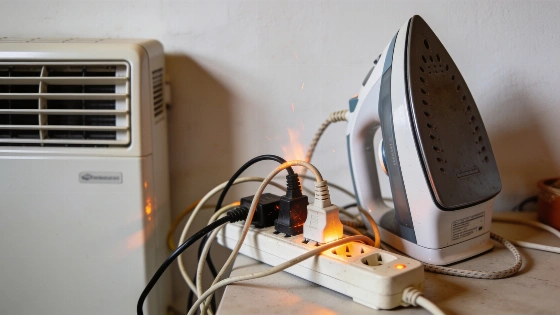
Plugging both an iron and an air conditioner into a single power strip can quietly push your home’s wiring past safe limits. Many Spanish households underestimate the combined wattage of these devices, risking overheating, appliance damage, and even fire.
Connecting an iron and an air conditioner to the same power strip may seem harmless, but this simple act can overload your home’s electrical system in seconds. Both appliances are notorious for their high energy demands, and when used together, they can easily exceed the safe capacity of most household power strips.
According to data cited by Talent24h, a typical power strip in Spain is rated for around 2,500 watts. However, the actual limit varies by model, and it’s crucial to check the manufacturer’s specifications before plugging in multiple devices. The real danger arises when the combined wattage of all connected appliances surpasses this threshold, causing cables and internal components to overheat.
High Wattage, Hidden Danger
Irons are often underestimated because they’re used for short periods, but their power consumption is significant. Depending on the model, a household iron can draw anywhere from 1,000 to 3,000 watts. At the upper end, a single iron already exceeds the standard 2,500-watt reference for many power strips. The number of available sockets on a strip does not indicate how much power remains—what matters is the total wattage of devices running at the same time.
Air conditioners, especially portable or window units, also demand substantial power. Smaller models typically require between 1,500 and 2,000 watts, while larger units can exceed 4,000 watts. In these cases, the air conditioner alone can surpass the safe limit for a standard power strip. Adding an iron to the mix only increases the risk of overheating and potential electrical failure.
Calculating the Real Risk
To determine if you’re at risk of overloading a power strip, add up the wattage of every appliance you plan to use simultaneously. For example, pairing a 1,000-watt iron with a 1,500-watt air conditioner brings you exactly to the 2,500-watt mark. But if you use a 3,000-watt iron and a large air conditioner over 4,000 watts, the total can exceed 7,000 watts—nearly three times the recommended limit. This level of demand can quickly lead to overheating, damaged appliances, and, in the worst cases, fire.
Overheating and Fire Hazards
When a power strip is pushed beyond its capacity, the cables and internal parts can become dangerously hot. This not only threatens the lifespan of your appliances but also increases the risk of electrical fires. Even if a fire doesn’t break out, repeated overheating can cause lasting damage to both the power strip and the devices connected to it.
To reduce these risks, experts recommend never using an iron and an air conditioner on the same power strip. Always check the wattage of each appliance and compare it to the maximum rating of your power strip before plugging in. The Agencia de Seguridad y Emergencias Madrid 112 advises using only certified power strips and avoiding overloading them. For high-wattage devices like heaters, it’s safest to plug them directly into a wall outlet.
Practical Advice for Spanish Homes
While alternatives to traditional power strips exist, every multi-socket device has a maximum capacity that must be respected. Overlooking these limits can have serious consequences, especially in older buildings with outdated wiring. Taking a few moments to check appliance wattage and power strip ratings can prevent costly damage and keep your home safe.