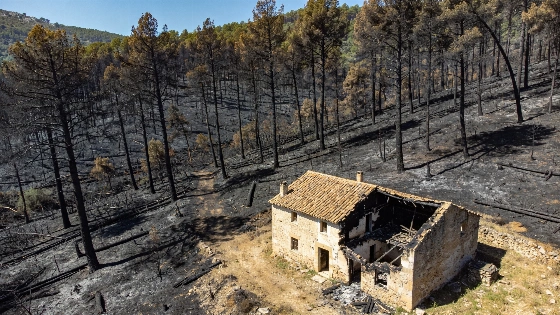
A wildfire broke out near La Vall d’Uixó in Castellón on Saturday, July 25, 2026, prompting the evacuation of 12 municipalities in and around the Sierra de Espadán natural park and emergency measures across 18 municipalities. At the height of the fire, authorities estimated that about 75,000 people were affected by evacuations or confinement orders. Later reports put the number actually evacuated at around 16,000, distinguishing those who left their homes from the much larger population affected by restrictions.
At the height of the emergency, the fire had scorched an estimated 6,500 hectares, with its perimeter stretching about 48 kilometers. The final burned area was later estimated at approximately 9,568 to 9,600 hectares, making the initial figure provisional. RTVE later described the blaze as one of the Valencian Community’s largest fires during the period and the region’s third most impressive wildfire of the previous decade.
Emergency services focused on public safety as the fire spread. In the initial response, 43 people received medical treatment, mainly for smoke inhalation and, in some cases, burns. Nineteen were hospitalized. Ten of them were chronic patients who required oxygen support at the Hospital de Atención a Pacientes Crónicos y de Larga Estancia La Magdalena.
The flames entered the Sierra de Espadán natural park, the region’s second-largest protected area after Hoces del Cabriel. The park covers 31,180 hectares and includes 19 municipalities, most of whose land is privately owned. Of the 12 municipalities initially evacuated, Aín, Eslida, Azuébar, Almedíjar, Chóvar, Fuente de Ayódar, Alcudia de Veo and Villamalur lie entirely within the park. Alfondeguilla, Artana, Sueras and Tales are partly within its boundaries. Further evacuations affected Vilavella, Ayódar, Torralba, the Artesa district of Onda, neighborhoods in La Vall d’Uixó and residential areas in Betxí.
About 3,688 hectares of the final burned area lay within the natural park, roughly 12% of its surface, information from October reporting by El Periódico Mediterráneo. The fire damaged protected habitat as well as forest and land beyond the park. Strong westerly winds initially drove the flames toward the coast and industrial towns such as Onda. By Sunday, sea breezes had redirected them deeper into the park. Authorities had cleared urban centers as a precaution, while damage to the park’s cork oak forests remained to be assessed.
The Generalitat extended evacuation and confinement orders through 23:59 on Monday, July 27, with changes depending on the fire’s development. Forecasts of higher humidity and lighter winds raised the prospect of more stable conditions by Tuesday. Around 700 evacuees were housed in temporary shelters in Moncofa, Onda, Nules and Segorbe. During the night, 113 residents of the Novaedat care home in La Vall d’Uixó were transferred to facilities in Cullera, Carlet, Borriana, Estivella and Castelló.
Authorities later confirmed that the fire was intentional. In October, nearly three months after it started, investigators were still trying to identify the person responsible, RTVE reported. Protecting lives and property had been the initial priority. Restoration and assessment work followed as the emergency response shifted to recovery. The President of the Government, Pedro Sánchez, was scheduled to visit the affected area on Monday. Similar mass evacuations have taken place in the region in recent years, including when thousands were forced from their homes during previous wildfires in Castellón.
The post-fire response includes a €4.2 million emergency works program for forest and track restoration, safety improvements and repairs to the CV-219 and CV-223 roads. Europa Press reported that the Generalitat’s Third Vice-Presidency and Department of Environment, Infrastructure, Territory and Recovery were advancing the work.
Recovery efforts have also targeted damage to wildlife habitat. The Generalitat reported that two nests belonging to Bonelli’s eagle (Aquila fasciata) were destroyed in the fire and later rebuilt by its height-intervention team, working with the Wildlife Service and Natura 2000 network. Classified as endangered in the Valencian Community, the species depends on nesting habitat that can be difficult to reach on rocky cliffs. Rebuilding the nests required specialized vertical-access techniques.
The blaze was part of a wider severe wildfire season in the Valencian Community. Four major fires described in regional reporting as “sixth-generation” fires, in Vall d’Uixó, Tuéjar, Tírig and Segorbe, burned approximately 11,750 hectares combined. Levante-EMV reported 140 forest fires and outbreaks between June and September 2026. The Sierra de Espadán’s biodiversity and well-preserved landscapes make the fire’s long-term ecological effects impressive to local communities, as well as to tourism and agriculture that depend on the surrounding environment.