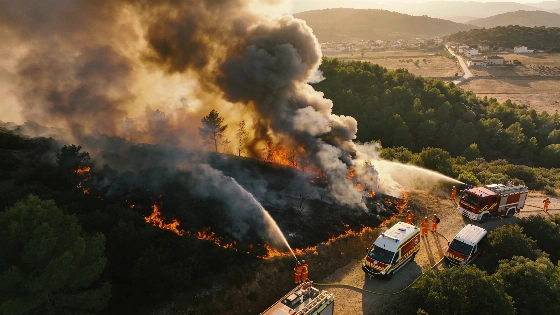
A massive wildfire in La Mierla has led to the evacuation of 1,200 people across 32 villages. Over 26,000 hectares have burned. Authorities struggle to contain the blaze as it threatens homes and disrupts local life.
The wildfire that erupted in La Mierla, in the Sierra Norte of Guadalajara, has now forced the evacuation of 32 villages and affected more than 26,000 hectares, making it the largest blaze ever recorded in Castilla-La Mancha. The fire, which began on Thursday, continues to spread rapidly, with its main front still out of control. Emergency services have evacuated an additional nine population centers in recent hours, bringing the total number of displaced residents to 1,200. The perimeter of the fire has expanded to 120 kilometers, with 10 kilometers added just overnight.
Authorities have prioritized the protection of urban areas and the safety of residents. Most evacuees have found shelter with relatives or returned to their primary homes, while others are being housed in a Red Cross shelter set up in the Humanes sports center. Additional accommodation with 120 beds has been prepared at the Brianda de Mendoza Institute in Guadalajara, and further capacity will be added at the Los Guzmán Student Residence if needed. Five more villages—Albendiego, Ujados, Cañamares, Tordelloso, and La Miñosa—remain under confinement orders as a precaution.
The firefighting operation is one of the largest in recent memory, involving 200 UME personnel, numerous forest and urban fire brigades from Castilla-La Mancha and neighboring provinces, and support from the Ministry for Ecological Transition. Up to 26 aircraft are conducting water drops to slow the advance of the flames, which now threaten the slopes of Alto Rey, a peak nearly 1,900 meters high. The rugged terrain, marked by valleys and ravines, combined with strong winds, has complicated efforts to contain the fire. Firebreaks and containment lines are being established wherever ground crews can reach, with local farmers from the Atienza area also assisting in the response.
So far, the coordinated defense has prevented the fire from entering residential areas, with the exception of a rural hotel and a few isolated buildings. However, the head of the fire remains highly active and has split into two fronts. Two forest firefighters required medical attention after an incident with a fire engine, but both are reported to be in good condition. The regional president, Emiliano García-Page, has acknowledged that the fire will continue to consume land for now, but stressed that the absolute priority is safeguarding lives and urban centers. He also confirmed that a restoration and recovery plan will be launched once the emergency is over, with support requested from the national government.
The impact of the fire extends beyond the immediate threat to homes. The Sierra Norte de Guadalajara, a natural area spanning 117,000 hectares, is a key region for forestry, livestock, and rural tourism. The destruction has already led to the suspension of youth camps and the temporary closure of a silica mine in Naharros to facilitate evacuations. Rural accommodation providers are facing a lost summer, especially as the area was considered one of the best spots in Spain to view the August solar eclipse. The financial toll is significant, with regional authorities estimating costs at nearly 50 million euros—about 20,000 euros per hectare burned.
As the situation evolves, the fire in La Mierla has drawn comparisons to previous major wildfires in the region, such as the 2005 La Riba de Saelices incident, which burned 13,000 hectares and resulted in the tragic loss of 11 firefighters. Unlike that event, the current blaze has not caused fatalities, but the scale of the environmental, social, and economic damage is unprecedented for the area. For further background on the progression of wildfires in Guadalajara and earlier evacuations, see this detailed report on the initial stages of the crisis: how the emergency response began as the fire first spread.
Wildfires are a recurring threat in Spain, particularly during the summer months when high temperatures and dry conditions prevail. The country has invested heavily in prevention and rapid response, but extreme weather and challenging terrain continue to test emergency services. The events in La Mierla highlight the ongoing vulnerability of rural communities and the importance of coordinated action between local, regional, and national authorities. As recovery plans are prepared, attention will turn to restoring the landscape and supporting those whose livelihoods depend on the Sierra Norte’s natural resources.