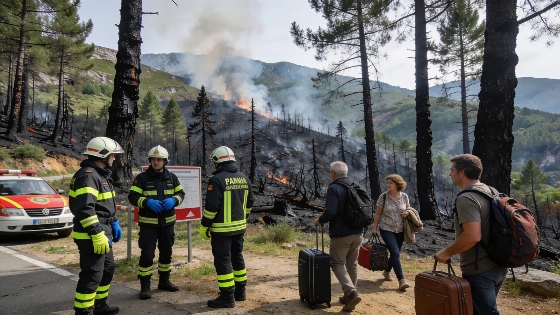
A major wildfire in Las Hurdes has destroyed 3,700 hectares of pine forest. Over 800 residents have been evacuated and 1,200 remain confined. Authorities are expanding emergency measures as conditions shift.
Emergency services in Las Hurdes (Cáceres) are battling a wildfire that has already consumed 3,700 hectares of pine forest and forced the evacuation of more than 800 people from eleven villages. The fire, which began intentionally on Tuesday near Pinofranqueado, has now reached the province of Salamanca, prompting authorities to escalate their response and maintain strict safety measures for affected communities.
Overnight, cooler temperatures and increased humidity provided some relief, slowing the fire’s advance and raising hopes that rain forecast for Thursday could further help containment efforts. Despite these improvements, the Junta de Extremadura has kept the evacuation order in place for Aceitunilla and continues to enforce the confinement of Nuñomoral’s 1,200 registered residents. Although Asegur was initially evacuated, most residents were allowed to return home during the night, except for those considered especially vulnerable.
The coordinated response involves more than 170 personnel, including thirteen forest firefighting units, six heavy machinery teams, and support from the Unidad Militar de Emergencias (UME), as well as resources from the Ministry for Ecological Transition (MITECO), SEPEI firefighters from the Diputación de Cáceres, and the Guardia Civil. The regional government has declared level 2 emergency status under both the Infoex and Infocaex plans, enabling the deployment of additional resources from outside Extremadura to protect people and property.
Evacuated residents are being housed in the Gregorio Marañón student residence in Caminomorisco. The affected villages include Horcajo, Avellanar, Erías, Castillo, El Gasco, Martilandrán, Aldehuela, La Fragosa, Robledo, Cerezal, and Aceitunilla. Medical support is available at the Advanced Command Post in Pinofranqueado, with a mobile medical unit and access to nearby health centers to ensure that those displaced can receive necessary medication and care.
In Salamanca, the fire has impacted two small areas near Agallas and Vegas de Domingo Rey, but both hotspots are now under control, according to the Junta de Castilla y León. The situation remains dynamic, with authorities closely monitoring weather changes and fire behavior to adjust their strategy as needed.
This incident highlights the ongoing wildfire risk in Spain’s rural regions, especially during periods of high temperatures and dry conditions. The rapid mobilization of emergency resources and the scale of evacuations in Las Hurdes echo the challenges faced in other parts of the country, such as the Sierra Oeste, where regional governments have previously allocated significant aid to support recovery after wildfires, as seen in Madrid’s recent grant program for affected businesses. The current focus in Las Hurdes remains on containment, safety, and support for displaced residents as authorities work to bring the situation under control.
Wildfires are a recurring threat in Spain, particularly in forested and mountainous areas like Las Hurdes. The combination of intentional ignition, challenging terrain, and variable weather can complicate firefighting efforts. Regional emergency plans such as Infoex and Infocaex are designed to coordinate rapid response and resource allocation across administrative boundaries. The involvement of national and military units underscores the seriousness of the current situation. Continued vigilance and community cooperation are essential as the region faces the ongoing risk of fire and its aftermath.