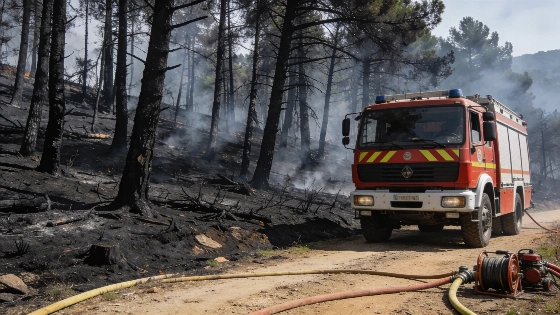
A major wildfire in Vall d’Uixó has destroyed 7,200 hectares and forced 16,000 evacuations. Authorities warn of worsening conditions as a heatwave nears. Investigators suspect arson as the cause.
The wildfire that erupted Saturday morning in a residential area of La Vall d’Uixó, Castellón, has rapidly expanded, consuming 7,200 hectares—most of them within the protected Sierra de Espadán natural park. With the fire still out of control, emergency teams are racing to contain its advance as authorities brace for a new heatwave that threatens to complicate efforts further.
On Monday, Prime Minister Pedro Sánchez visited the Advanced Command Post in La Vall d’Uixó, where he described the coming hours as “difficult and complex.” He highlighted the increased risk posed by rising temperatures and called on residents to exercise maximum caution. The government is set to approve a royal decree declaring the affected area a zone of serious civil protection emergency, aiming to expedite aid and recovery measures.
Firefighting resources have been stretched thin, with over 400 ground personnel and 25 aircraft deployed across three critical fronts: Eslida, the Montserrat urbanization in Betxí, and the Montí area in Onda. The director of firefighting operations, Fernando Pérez, confirmed that the blaze remains neither controlled nor stabilized, and that strong winds—reaching up to 30 km/h—are hampering containment. Authorities have maintained the evacuation order for 16,000 people as the situation remains volatile.
Investigators from the Guardia Civil’s Seprona unit are focusing on the possibility of arson, after several ignition points were detected early Saturday. Multiple individuals have already been questioned as part of the ongoing inquiry, though officials caution that determining the exact cause will take time. The president of the Generalitat, Juan Francisco Pérez Llorca, has called for tougher penalties if intentional action is confirmed, describing such acts as environmental crimes with lasting consequences.
This incident is part of a broader pattern of severe wildfires across Spain this summer. According to government figures, more than 170,000 hectares have burned in a dozen major fires—six times the area lost by this point last year. The scale of the crisis has prompted renewed calls for a national pact on climate emergency, with Sánchez emphasizing the need for coordinated action at all levels of government.
Local officials, including Tania Baños, mayor of La Vall d’Uixó, have stressed the importance of unified response and long-term recovery for the Sierra de Espadán, a landscape deeply woven into the community’s identity. As helicopters crisscross the sky and ash falls over the town, the focus remains on halting the fire’s advance and preparing for the challenges ahead.
Spain has faced a series of devastating wildfires in recent years, with climate change contributing to hotter, drier summers and increased fire risk. The Sierra de Espadán, known for its biodiversity and scenic value, is one of the largest natural parks in the Valencian Community. The current emergency follows other major incidents in the region, such as the mass evacuations in Castellón reported during previous wildfire outbreaks—details of which can be found in coverage of earlier evacuations in Castellón.
As the heatwave approaches, emergency services remain on high alert, and the coming days will be critical for both containment and the safety of affected communities. The government’s response and the outcome of the ongoing investigation are expected to shape future wildfire prevention and management strategies across Spain.