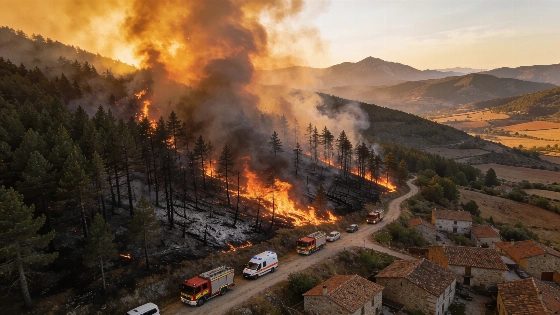
A new wildfire has erupted in El Bierzo, León, just a year after devastating blazes. Residents voice frustration over limited resources and slow aerial support as evacuations continue in affected villages.
El Bierzo, a region in León already scarred by last year's wildfires, is once again facing a major blaze. The latest fire, which began as a small outbreak near Castropodame, quickly spread through the mountainous terrain of San Pedro Castañero, consuming dense forest that had flourished over the winter. Local residents, many of whom remember the destruction of 2025, have expressed growing frustration at what they see as insufficient prevention and a lack of rapid response from authorities.
As the flames advanced, villagers in San Pedro Castañero—home to just 100 people—were forced to evacuate children and elderly residents overnight. Those who remained took to the hills in four-wheel drives, trying to assess the damage and monitor the fire’s unpredictable path at elevations reaching 1,300 meters. The mayor, Román Díaz (PSOE), joined locals in their efforts, highlighting the sense of abandonment many feel. Calls for more aerial firefighting support went unanswered for hours, despite the visible threat to pine forests and homes.
Residents pointed out that areas where undergrowth had been cleared by locals fared better against the fire, while unmanaged sections allowed flames to climb into the treetops and spread rapidly. The frustration was compounded by the fact that many firefighting brigades were already deployed to other hard-hit provinces like Guadalajara and Segovia, leaving El Bierzo with limited resources. The regional government, Junta de Castilla y León (PP-Vox), has faced criticism for what locals describe as a lack of winter preparation, insufficient firebreaks, and minimal local involvement in forest management.
Authorities reported that the fire’s origin appeared accidental, with evidence suggesting it may have started during chainsaw work for wind farm infrastructure. A 16-liter gasoline can and seven liters of oil were found at the scene, and the incident is under investigation by the Guardia Civil. While the Junta prohibits risky activities during heatwaves, exceptions are made for emergency or public interest works if properly notified. Firefighters on the ground noted that such exceptions, combined with stretched resources, can leave vulnerable areas exposed.
Throughout the night, favorable wind conditions helped slow the fire’s advance, but by morning, the situation remained tense. Burned road signs, blackened undergrowth, and scorched boundaries marked the landscape. Only the network of rural paths prevented further spread, but the risk remains high as temperatures rise. Military emergency units arrived to support local efforts, while some residents returned briefly to salvage belongings from evacuated homes.
One resident, Adolfo Marón, described the intensity of the night’s flames, recalling how smoke and fire made visibility nearly impossible. The sense of déjà vu is strong in El Bierzo, with many fearing a repeat of last summer’s devastation. The fire comes as Spain faces ongoing extreme weather, with authorities elsewhere issuing alerts for storms and high fire risk, as seen in recent reports of severe weather in Valencia and Murcia—where storms and heatwaves have also heightened wildfire dangers.
Spain’s wildfire season has grown longer and more intense in recent years, driven by hotter, drier conditions and changing land use. El Bierzo’s experience highlights the challenges of rural depopulation, limited firefighting resources, and the need for year-round forest management. As the summer progresses, the region remains on high alert, with residents and local officials urging authorities to prioritize prevention and rapid response to avoid further loss.