A major wildfire in Huesca has endangered the region’s largest second-hand bookstore. Over 240 residents from several villages were evacuated as flames approached homes and businesses.
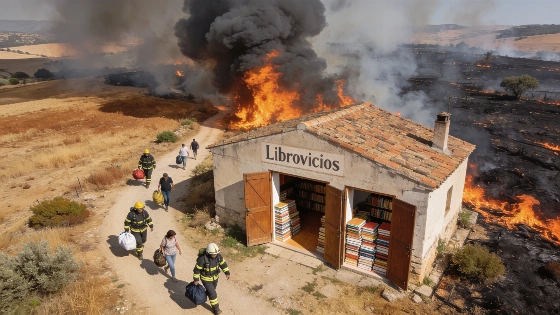
A massive wildfire in Huesca has put one of Aragón’s most significant cultural assets at risk: Librovicios, the largest second-hand bookstore in the region, located in the small village of Azanuy. The fire, which broke out between Tamarite de Litera and Alcampell, forced the evacuation of more than 240 residents from Azanuy, Alins del Monte, and Calasanz. Among those displaced were Pep Ors and Ana Obis, owners of Librovicios, who left behind a collection of over 33,000 books as flames threatened their home and business.
Emergency services responded quickly, relocating dozens of villagers to a sports residence in Monzón. While some evacuees found shelter with relatives, others had no choice but to stay in temporary accommodation. The situation was especially tense for Ors and Obis, who spent the night anxiously awaiting updates, knowing that if the fire reached their property, their entire inventory could be lost in minutes.
Authorities also imposed a temporary lockdown on Fonz, one of the largest towns in the affected area, confining its 886 residents to their homes as a precaution. The restriction was lifted the following morning when conditions improved and smoke cleared from the town. Despite the scale of the evacuation, many residents expressed frustration over the abruptness of the orders and the uncertainty about when they could return home.
By Friday, the wildfire had already consumed more than 2,000 hectares, with firefighters working to secure a 4,000-hectare perimeter. Officials, including the subdelegate of the Government in Huesca, José Carlos Campo, reported that the fire’s spread had been contained and expressed hope that stabilization would be achieved by Saturday, provided weather conditions remained favorable. The regional government’s tourism and environment minister, Luis Biendicho, noted that firefighting efforts were now focused on the right flank of the blaze, where dense forest posed ongoing challenges.
Residents described the fear and confusion caused by the rapid evacuations. In Calasanz, villagers were given just five minutes to leave, only to return later when it became clear the fire was still distant. Power outages and repeated evacuations added to the stress, with some worried about food supplies left behind in their homes. The fire reportedly started when a spark from a harvester ignited dry vegetation, highlighting the ongoing risk during periods of high alert.
While the immediate threat to Librovicios and the surrounding villages appears to be receding, the incident underscores the vulnerability of rural communities and cultural landmarks to extreme weather events. Aragón, like much of Spain, faces increasing wildfire risks each summer, with authorities urging maximum caution and public cooperation to prevent further disasters. The story of Librovicios echoes the broader challenges faced by local businesses and residents in the face of natural emergencies, much like the resilience shown by Spanish journalists in adapting to changing circumstances, as discussed in a recent piece on the evolution of Spanish radio icons.
For context, Spain has seen a rise in large-scale wildfires in recent years, often linked to prolonged drought and high temperatures. Rural depopulation can leave villages with fewer resources to respond to emergencies, making coordinated action by authorities and communities essential. The events in Huesca highlight the importance of preparedness and the impact such crises can have on both daily life and the preservation of local heritage.