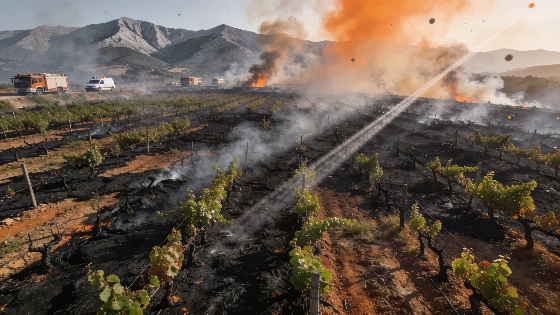
Wildfires have destroyed historic vineyards across Ávila and Madrid. Growers face major losses, with concerns rising over smoke taint in upcoming wine harvests. The full scale of the damage is still emerging.
Wildfires sweeping through the Valle del Tiétar and El Escorial have left a trail of destruction across some of Spain’s most renowned wine regions. In recent days, flames have consumed decades-old vineyards, with growers in Ávila and Madrid reporting severe losses and growing uncertainty about the future of their harvests. The immediate concern is not only the loss of vines but also the risk that smoke may compromise the taste and quality of this year’s wines.
Producers in the Gredos area, such as Fernando from El Abuelo Wine, are facing the reality of losing entire plots. In La Rinconada (Ávila), two parcels totaling 10,000 square meters have been completely destroyed, while others have suffered partial damage or have narrowly escaped the flames. The traditional layout of these vineyards, often surrounded by granite and adjacent to dry vegetation, has made them particularly vulnerable. EU regulations requiring ground cover between vine rows until June have inadvertently created pathways for fire to spread rapidly.
Hugo González, who manages nearly 20 hectares in Cebreros, estimates that up to 30% of his oldest plots—some dating back to 1808—are lost. The impact is not limited to vines; the entire ecosystem has suffered, as noted by Jesús Soto of Bodegas Soto y Manrique, who has also seen several hectares affected. The fires have hit both small family plots and larger operations, with some producers criticizing land management policies that leave inactive fields overgrown and prone to fueling wildfires.
While some vineyards have been devastated, others have narrowly avoided disaster. Comando G, a highly regarded winery in Gredos, managed to save its prized Las Iruelas plot, though smoke damage is expected to halve this year’s yield. Daniel Landi, one of the founders, highlights the broader issue of rural neglect and the challenges facing Spain’s primary sector. The debate over land use and fire prevention is intensifying as the region recovers.
In San Martín de Valdeiglesias (Madrid), Bodega Marañones reports that its 35 hectares remain untouched, though uncertainty lingers over the potential impact of smoke on the grapes. Similar concerns are echoed by Bodegas y Viñedos Bernabeleva, which credits firefighters for saving its vineyards at the foot of the Cerro de Guisando. Access to some affected wineries, such as Las Moradas de San Martín, remains restricted as authorities continue their assessments.
Maite Sánchez, oenologist at Arrayán, notes that most of her vineyards near Almorox (Toledo) and San Martín have been spared, with only minor damage in Cebreros. However, the risk of smoke taint remains a pressing issue for many producers. José Luis Benítez, director general of the Federación Española del Vino, points out that while there are costly systems to analyze and mitigate smoke effects, the value of well-maintained vineyards as natural firebreaks should not be underestimated.
Further afield, vineyards in Albacete, such as those managed by Manuel Manzaneque, have escaped the worst of the fires. However, the overall picture remains grim, with the full extent of the damage still being mapped. As highlighted in recent reports on the broader wildfire crisis in central Spain, the wine sector is only beginning to reckon with the consequences of this disaster.
Spain’s wine industry is a vital part of the national economy and cultural heritage. The regions affected by these fires are known for producing distinctive wines, particularly from garnacha and albillo real grapes. The destruction of old vines, some nearly a century old, represents not just an economic loss but also a blow to local identity and tradition. As authorities and growers assess the aftermath, attention is turning to long-term recovery, the need for improved land management, and the challenge of adapting to increasingly frequent extreme weather events. The coming weeks will be critical in determining the true scale of the losses and the prospects for the next harvest.