Spain faces its largest wildfire on record as flames devastate Ávila, Madrid and Toledo. Over 77,000 hectares are affected. Authorities evacuate or confine 90,000 people. Emergency measures expand as conditions worsen.
Spain is battling one of its most severe wildfire crises in recent history, with blazes in Ávila, Madrid and Toledo now affecting more than 77,000 hectares and forcing around 90,000 residents to evacuate or remain confined. The fire in Ávila alone has become the largest ever recorded in the country, prompting the government to declare the impacted areas as severely damaged by emergency.
Efforts to contain the fires have been hampered by strong winds and challenging weather. Although some progress was made on Sunday, with several fronts slowed, multiple active hotspots remain and the fires are not yet fully contained. Emergency teams, including the Unidad Militar de Emergencias (UME), are treating the situation as a single large-scale incident, with the national emergency status now extended to Toledo.
In Madrid’s Sierra Oeste, 25,000 hectares have burned, and conditions for firefighters have deteriorated compared to the previous day. Meteorological forecasts predict a sharp rise in temperatures, with Monday marking the last day below 35°C before a spike to 38°C. Relative humidity is expected to drop below 20% during peak hours, further complicating firefighting efforts. Authorities are particularly concerned about the risk of the flames from Burgohondo in Ávila merging with those advancing from Madrid, a scenario that could escalate the crisis.
According to the Ministry of the Interior, the fires have intermittently converged but have not fully merged into a single front. The proximity and scale of the blazes have created erratic fire behavior, with the potential to generate their own microclimates and sudden wind gusts. This unpredictability remains a major challenge for technical teams on the ground, as the fires can produce towering smoke columns and spread ash over long distances.
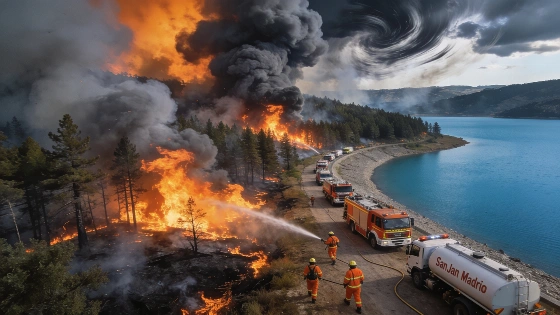
Firefighters have focused their overnight efforts on three critical areas in Madrid: the Cofio river area, the El Encinar del Alberche urbanization in Villa del Prado—which faced a second evacuation—and the southern urbanizations near the San Juan reservoir by San Martín de Valdeiglesias. While the eastern flank has been stabilized, the western side, closer to Ávila, continues to pose significant threats. Twelve municipalities in Madrid have been evacuated, with four more under confinement, affecting over 50,000 people. Some positive developments include the return of 4,500 evacuees from the El Escorial campsite and the reopening of a senior residence in San Martín de Valdeiglesias.
In Ávila, the Burgohondo fire remains uncontrolled but is advancing more slowly. The situation in the Tiétar Valley is particularly tense, with evacuations and intensified firefighting operations underway. The Guardia Civil has detained one individual and is investigating another for allegedly using heavy machinery in a restricted area, which may have sparked the initial blaze. Regional authorities have announced plans to join the legal case against those responsible for starting the fire.
Toledo has also been placed under national emergency, with a fire in Almorox leading to the evacuation of 5,200 residents across 11 towns. For many, this marks the fourth consecutive night spent away from home. The scale of the crisis has drawn comparisons to previous wildfire emergencies in Spain, but the current situation stands out for its unprecedented size and the number of people affected.
As the fires continue, authorities are allowing limited access for livestock farmers to tend to their animals under strict safety protocols. Local mayors are coordinating these efforts, ensuring that essential needs are met while prioritizing public safety. The ongoing emergency highlights the vulnerability of rural and peri-urban communities to extreme weather and the growing complexity of wildfire management in Spain.
For further context on the evolving wildfire situation and its impact on local communities, see this report on how Talavera de la Reina and Escalona have become temporary shelters for evacuees: Hundreds find refuge as wildfires force mass evacuations in Ávila and Madrid.
Wildfires have become an increasingly frequent threat in Spain, particularly during periods of prolonged heat and drought. The current emergency underscores the need for coordinated response strategies and highlights the challenges posed by climate variability. As authorities work to stabilize the situation, the focus remains on protecting lives, property, and critical infrastructure in the affected regions.