Blockhaus Changes the Course of the Giro d’Italia: Battle for Leadership on the Longest Stage. Stage seven of the 2026 Giro d’Italia unfolds amid strong winds and challenging terrain. The finish at Blockhaus could reshape the overall standings. The spotlight is on the battle among favorites and the breakaway of the day.
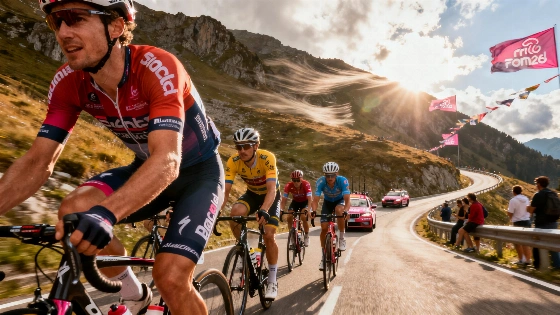
The seventh stage of the 2026 Giro d’Italia became a key test for the contenders: riders are faced with the longest route of this edition — 245 kilometers from Formia to the legendary Blockhaus climb. Here, at one of the most challenging finishes in Giro history, the fate of the leader’s jersey may be decided. All eyes are on a possible attack from Jonas Vingegaard, who could shift the balance of power in the general classification.
From early morning, the stage is held under changeable weather: overnight, wind gusts of over 60 km/h were recorded at Blockhaus, and by the time of the climb, steady winds of 17 km/h are expected. Despite this, organizers did not change the finish location. Temperatures at the start remain around 18 degrees, while at the Blockhaus summit, only 5 degrees and variable cloudiness are forecast.
The peloton is riding cautiously but tensely: the Visma and Bahrain-Victorious teams are controlling the race, defending the interests of Jonas Vingegaard and current leader Afonso Eulalio. In the day’s breakaway are Diego Pablo Sevilla, Jonathan Milan, Van der Lee, Naberman, and Nickolas Zukowsky. This group’s advantage fluctuates between 3 and 6 minutes, and Zukowsky is the main rival from the break in the overall standings, although his deficit exceeds 22 minutes.
Special attention is focused on the intermediate sprints and the battle for mountain points. Jonathan Milan has already narrowed the gap in the maglia ciclamino classification, while Diego Pablo Sevilla could strengthen his position in the mountains classification if the break survives to Blockhaus. Among those who could challenge for the general classification are Enric Mas, Igor Arrieta, and Markel Beloki, who also maintain solid chances.
Before the decisive climb, the riders pass through Roccaraso, which this time is not included in the list of official mountain points, but still demands extra effort from all participants. The peloton is gradually closing the gap, while the breakaway maintains a steady pace. All 169 athletes who completed the previous stage started today—no withdrawals have been recorded.
Visual footage from the course highlights the tension: Jonas Vingegaard shows confidence, greeting the cameras ahead of the crucial climb. According to RUSSPAIN, such moments can prove pivotal for the entire race, as has happened at other major cycling competitions. For comparison, River Plate’s recent success in the Torneo Apertura quarterfinal also resulted from a decisive episode, which was examined in detail in the article about the club reaching the semifinals after an intense battle.
The outcome of the stage and a possible change of leader in the general classification will depend on how the favorites cope with the final climb. Blockhaus is traditionally regarded as one of the toughest challenges of the Giro d’Italia: its steep slopes and unpredictable weather have often set the stage for unexpected outcomes. In 2026, this section may once again prove crucial for the final allocation of the leader’s jersey and the battle for mountain points. It is important to note that the Giro d’Italia is one of the three biggest multi-day cycling races in the world, and Blockhaus ranks among the most famous climbs in European cycling. Victory or failure on this stage often shapes the course of the entire race.