Microsoft and NVIDIA are putting AI agents on Windows hardware. New containers and machines target local execution while reducing cloud traffic.
At Dogpatch Studios in San Francisco, Microsoft and NVIDIA executives shared the stage on 7 October 2026 to outline a Windows strategy built around local agents. The immediate goal is practical. Agents should run on the user’s machine with controlled access to files and networks. They can also invoke system tools.
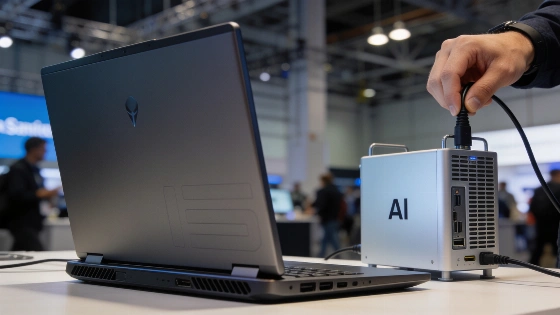
That plan needs hardware beyond a conventional laptop. The Surface Laptop Ultra is already available for preorder with up to 128 GB of unified memory. NVIDIA has previewed the DGX Station for Windows on the GB300 platform. The two systems target very different price and performance levels.
Windows session containers run an agent under a separate account and isolate the desktop, clipboard, user interface and input from the surrounding user session.
Microsoft Execution Containers, or MXC, provide the software foundation. Microsoft describes MXC as a policy-driven execution layer for potentially untrusted or dynamically generated code. Model output and plugins can run inside it. So can tools, an agent shell or the entire agent. Administrators can set which files an agent reads and which networks it reaches. They can also control the system tools it may invoke.
MXC is generally available on Windows 11. According to HotHardware, it will also work on Linux and macOS, extending Microsoft’s sandboxing layer beyond its own operating system. The first confirmed integrations include Codex and GitHub Copilot. OpenClaw, Replit, LM Studio, NVIDIA OpenShell and Unsloth AI are also included. Microsoft lists Anthropic Claude Code Box, Egnyte, Heidi Health, Hermes Agent, Manus, Perplexity, Raycast and Simular for announcements in the coming months.
The business case arrives before the most expensive machines. A startup selling an agent to companies in Spain or Latin America can present local execution as an alternative to sending every interaction and dataset to the cloud. For Windows-first engineering teams, MXC removes the need to build a separate isolation model for each supported environment.
Microsoft calls the broader approach hybrid intelligence. Windows can run agents locally and call cloud services when necessary. Shared security and administration controls remain in place. The promise sounds tidy. The available material confirms the architecture, but it does not establish the economic advantage of local execution or the production readiness of every partner integration.
Microsoft’s materials list Llama 4 Maverick, Kimi K2.6 and DeepSeek V4 Pro among models intended for local execution on DGX Station for Windows, including models with more than 1 trillion parameters.
The Surface Laptop Ultra is the clearest test of that proposition. Microsoft opened preorders on 7 October 2026 and expects shipments from 16 October. Prices start at US$2,599 for an 18-core N1X CPU with 24 GB of RAM and a 512 GB SSD. The 128 GB version was listed as sold out during the preorder period at US$5,899.
Intermediate configurations rise to US$3,300 with 32 GB of RAM and a 1 TB SSD. Another version costs US$3,600 with a 20-core CPU, 6,144 GPU cores and 32 GB. A US$4,000 model carries 48 GB, while the US$4,300 configuration has 64 GB. The RTX Spark N1X combines a Grace CPU with a Blackwell GPU and a unified memory pool reaching 128 GB.
Microsoft specifies up to 6,144 NVIDIA Blackwell RTX cores and up to 20 NVIDIA Grace CPU cores for the platform. NVIDIA says the system can deliver up to 1 petaflop of FP4 performance. It can run models of up to 120 billion parameters with a context of 1 million tokens locally. Those figures describe capacity. They do not prove that every listed model will deliver the same performance in every workload.
At the other end sits the DGX Station for Windows. NVIDIA describes it as a desktop supercomputer using GB300 Grace Blackwell Ultra technology with up to 748 GB of coherent memory. It reaches up to 20 petaflops of FP4 performance and is designed for local models of up to 1 trillion parameters.
The GB300 connects a Blackwell Ultra GPU with a 72-core Grace CPU through NVLink-C2C at 900 GB/s. Microsoft’s materials list Llama 4 Maverick, Kimi K2.6 and DeepSeek V4 Pro for local execution on the system. The listed models include versions with more than 1 trillion parameters.
Microsoft is also supplying a model layer. MAI Code 1.1 Flash has 137 billion total parameters, with 6.8 billion active parameters, and uses 3-bit precision. The company says it is up to 80% smaller than comparable architectures. On RTX Spark hardware, it supports 256,000 tokens of local context.
For ordinary Windows users, Search may show the most visible change. The bar is set to handle commands such as “cambia a modo oscuro” and “silencia el micrófono”. It will also accept “Texto a [nombre]…” and “Abre la última reunión de Calendar”. Search becomes a control point for the operating system instead of a tool used mainly to locate files.
The same shift is reaching physical workplaces. A factory-floor report from Alimentaria Foodtech 2026 described sensors, automation and live production tools bringing AI into industrial operations. Microsoft and NVIDIA are applying a comparable logic to the personal computer.
Enterprise administrators still need to track what an agent can do after it starts. Microsoft links MXC with Entra and the forthcoming Agent 365 control layer. The proposed controls distinguish actions performed by the user from actions performed by an agent.
MXC supports several isolation levels, including process and session isolation. It also supports WSL containers, virtual machines and Windows 365 for Agents. On Windows 365, agents can run on a Cloud PC beside a familiar work environment while retaining a separate isolation model.
Microsoft Ignite is the next confirmed milestone in November. The event is expected to bring deeper agents into Word and Excel. PowerPoint is also included, alongside the Microsoft 365 Copilot Wave 3 E7 plan priced at US$99 and connected to the MXC and Surface Laptop Ultra hardware layer.