The 2026 World Cup final in New Jersey is marked by political overtones. Trump’s involvement and Spain’s multicultural team have reignited debates on identity, power, and the use of football for national messaging.
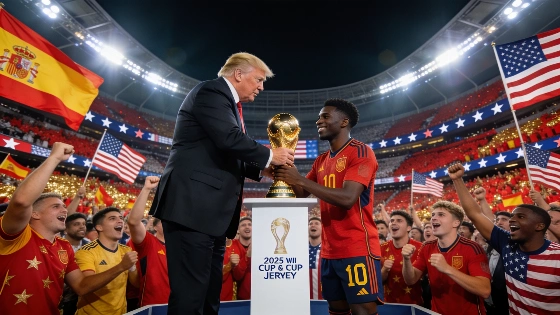
The 2026 World Cup final in New Jersey has become a focal point for political symbolism, with the tournament’s closing moments expected to feature Donald Trump presenting the trophy. This act, set against the backdrop of Trump’s frequent criticism of Spain and its Prime Minister Pedro Sánchez, has turned the sporting event into a stage for international and domestic power plays. The intersection of football and politics is not new, but this year’s competition has brought the issue to the forefront, especially as Spain’s national team, led by players like Lamine Yamal, challenges traditional narratives about national identity.
Political leaders have long used the World Cup to reinforce their regimes or project soft power. Historical examples include Benito Mussolini’s use of the 1934 tournament in Italy to promote fascism, and Argentina’s military junta leveraging the 1978 victory to distract from human rights abuses. In more recent years, Russia’s 2018 World Cup served as a platform for Vladimir Putin to display authority, while Qatar’s 2022 edition sparked global debate over human rights and the complicity of democratic states. The pattern is clear: host nations and their leaders often seek to harness the World Cup’s visibility for political gain, whether to bolster internal unity or reshape their international image.
This year, Trump’s direct intervention—reportedly contacting FIFA to advocate for a U.S. player—has underscored the extent to which political figures are willing to influence outcomes and narratives. Analysts note that the 2026 tournament stands out for two reasons: the unprecedented commercialization of the event, aligning football more closely with American sports marketing, and the prominence of multicultural squads at a time when anti-immigration rhetoric is on the rise. The diversity of teams like France and Spain has challenged outdated notions of national identity tied to ethnicity, with Spain’s own squad offering a vivid example.
Spain’s national team has become a symbol of the country’s evolving identity. The success of La Roja in 2010 was previously used to promote messages of internal unity and integration, especially as regional tensions grew. Now, with players such as Lamine Yamal—of Moroccan descent and Muslim background—potentially leading Spain to victory, the team’s composition is forcing a reconsideration of what it means to represent the nation. Political parties that have historically opposed immigration may find themselves celebrating a player whose background contradicts their usual stance, highlighting the complex relationship between sport, politics, and society.
Not all attempts to use the World Cup for political purposes succeed. Brazil’s 2014 tournament, intended to showcase national progress, was overshadowed by mass protests over public spending. In Argentina, the 1978 World Cup’s propaganda value was undermined when international journalists exposed the stories of the disappeared. The risk for any host or political leader is that the global spotlight can just as easily reveal uncomfortable truths as it can project carefully crafted images.
For Spain, the 2026 final is more than a sporting milestone. It is a moment that encapsulates ongoing debates about diversity, national unity, and the role of football in shaping public discourse. The presence of Trump at the trophy ceremony, and the possibility of a decisive goal from a player like Lamine Yamal, ensure that the event will be remembered not only for its athletic achievements but also for its political resonance. This dynamic echoes broader trends in European football, as seen when Zinedine Zidane’s leadership of France was discussed in the context of national renewal after Deschamps’ long tenure—a topic explored in detail in our coverage of France’s coaching transition.
Contextually, the World Cup’s political dimension is deeply rooted. Since its inception, the tournament has mirrored global shifts, from the use of sport as propaganda to the celebration of multiculturalism. In Spain, football has often served as a barometer for broader social changes, reflecting tensions and aspirations within the country. As the 2026 final unfolds, the interplay between politics and sport remains as pronounced as ever, with the outcome likely to influence not just football fans, but also ongoing conversations about identity and power in Spain and beyond.