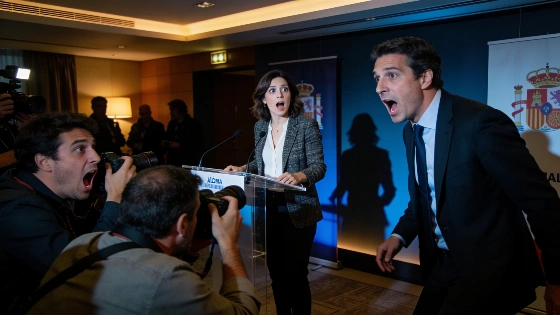
Businessman Víctor de Aldama interrupted a press conference in central Madrid featuring Leire Díez, a former PSOE militant at the center of controversy surrounding the party. The event, held a year ago, caught the attention of former Prime Minister José Luis Rodríguez Zapatero, who shared his impressions with his personal secretary. Internal messages show that Zapatero viewed Díez’s performance positively, while noting the confusion caused by Aldama’s sudden appearance.
During the press conference, Díez denied being the so-called “fontanera” of Ferraz, a term used to describe someone allegedly involved in efforts to obstruct judicial investigations related to Prime Minister Pedro Sánchez and his family. Tensions rose when Aldama entered unexpectedly, accusing Díez of dishonesty and criticizing the government. The confrontation drew attention away from her statements. In a private exchange, Zapatero’s secretary said the disruption muddied the message and could negatively affect PSOE supporters.
Díez presented herself as an investigative journalist working on a book about state secrets. She insisted on her independence and rejected attempts at intimidation, describing herself as a free citizen exercising her rights. She said she would not abandon her convictions. She also declined to take questions from the press, further fueling speculation about her role and intentions.
The press conference took place amid allegations that Díez was connected to an effort to disrupt judicial proceedings involving the PSOE and the government, as well as members of Sánchez’s family. National Court judge Santiago Pedraz is directing the investigation, which examines alleged activities linked to Díez and former PSOE official Santos Cerdán. The case also includes allegations of pressure against Judge Beatriz Biedma, who handled proceedings involving the prime minister’s brother, David Sánchez Pérez-Castejón. These remain allegations under investigation, not a final judicial finding.
Reports have described contacts involving Díez, businessman Javier Pérez Dolset, former CD Badajoz president Joaquín Parra and former judge Luis José Sáenz de Tejada. The Guardia Civil’s Central Operative Unit, known by its Spanish initials UCO, reportedly prepared two reports concerning alleged pressure on Biedma. Díez acknowledged meeting Sáenz de Tejada so he could “tell things,” while rejecting the criminal interpretation attributed to the contacts. She also said that 70% of the WhatsApp* (принадлежит Metа, которая признана экстремистской организацией и запрещена в РФ) group “Vacaciones y Viajes” consisted of Parra discussing Badajoz and its affairs. Díez has called the UCO report “false” and described the wider allegations as “a farce” and “madness.”
On 23 October 2026, Pedraz ordered the PSOE to provide documents concerning its hiring of lawyers and other legal or consulting services through basic and territorial bodies between 2021 and 2025. The judge gave the party 15 days to submit the material “without further delay.” The order forms part of the investigation into the alleged network and said compliance could not be made conditional on extrajudicial steps initiated solely by the party.
The PSOE has invoked professional secrecy and lawyer-client confidentiality as it seeks to limit or clarify the scope of the request. The party’s organizational secretary, Rebeca Torró, said UCO reports contained “theories” and “hypotheses that do not have to be true.” She also said the party had not filed a criminal complaint against Díez because the investigation “has to move forward.”
In a separate development on 23 October 2026, Díez filed a criminal complaint against the Partido Popular over an artificial-intelligence-generated video portraying her as admitting to hiring assailants to harm Judge Biedma. She directed the complaint to Pedraz. The episode added a dispute over manipulated political media to the ongoing investigation, separate from the allegations concerning Díez’s contacts and activities.
The incident involving Aldama and Díez was part of wider disputes drawing attention to PSOE’s internal dynamics. In a related development, Díez was preparing to testify independently in court, a move that could increase pressure on the party leadership and deepen existing divisions, as detailed in this earlier report.
The Madrid press conference reflects the challenges facing the PSOE amid legal scrutiny and internal dissent. Ferraz refers to the party’s headquarters in Madrid and is often used as shorthand for its basic leadership. The investigations and competing public accounts have kept party loyalty and judicial independence at the center of Spain’s political debate, with public perception also in focus.