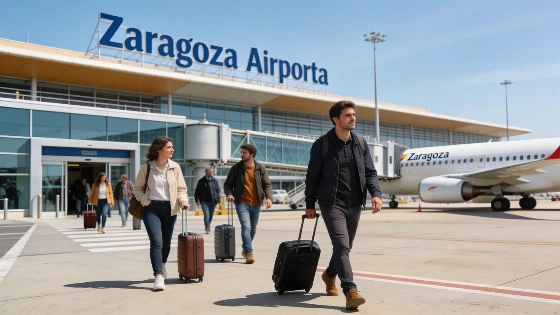
Zaragoza airport is set for a major expansion, with 20 new routes to 15 countries launching in March 2027. Supported by €8.8 million in public funding, the initiative seeks to elevate the city’s status in European aviation.
On March 28, 2027, Zaragoza airport will undergo a transformation rarely seen among Spain’s regional airports: expanding from 12 to 32 regular routes and linking the city to 15 countries. This is a deliberate, publicly funded effort to raise Zaragoza’s profile in European air travel. According to EFE and Diario del AltoAragón, the project is officially supported by both the Government of Aragón and the Zaragoza City Council, which have launched a public tender for 29 lots covering 31 routes. With the Palma connection already operating, the total will reach 32 destinations.
The scale of the expansion is evident in the figures. The Government of Aragón and the Zaragoza City Council are investing €8.8 million, aiming to exceed 1.3 million annual passengers. The strategy goes beyond simply adding flights: it’s about positioning the region as a significant destination for tourism and business, with a network stretching from Switzerland and Germany to Portugal and Morocco. Official forecasts cited by EFE indicate that, if fully implemented, Zaragoza airport could handle up to 1,376,390 passengers and offer more than 1.6 million seats annually—a sharp rise from the 648,487 passengers projected for 2026.
Before this expansion, Zaragoza airport operated 12 regular routes to 6 countries, with just under 4,000 flights and fewer than 650,000 passengers projected for 2026.
Four domestic routes—Ibiza, Málaga, Alicante, and Santiago de Compostela—are set to return, while the international expansion is even more ambitious. New destinations will include Manchester, Düsseldorf, Prague, Bratislava, Budapest, Warsaw, Krakow, Sofia, Pisa, Naples, Palermo, Porto, and Tangier, as well as Swiss cities such as Basel, Zurich, or Geneva. The plan is designed to serve both economic interests and the region’s diverse communities, including significant Romanian, Moroccan, and Bulgarian populations, and students involved in Erasmus exchanges. According to ABC and ElDiario.es, part of the strategy is to restore previously lost domestic and international links, not just to add new ones.
Not all routes will operate year-round. Of the 20 new connections, seven will be seasonal, running only during the summer months from April to October. These include Menorca, Krakow, Düsseldorf, Málaga, Bratislava, Porto, Manchester, and Ibiza—with Ibiza available exclusively in July, August, and September. The remaining routes are intended to provide year-round service, which is uncommon for many secondary Spanish airports. El Español notes that each contract will be reviewed after one year, with the option to extend for up to four years, allowing authorities to adjust the network based on performance and demand.
The official launch date for the new routes is set for March 28, 2027, aligning with the start of the IATA summer season. The project has been publicly presented by Aragón president Jorge Azcón, Zaragoza mayor Natalia Chueca, and infrastructure advisor Octavio López, who emphasize the goal of strengthening business, tourism, and international ties for the region.
Currently, Zaragoza airport serves 12 destinations in six countries, including four Spanish cities (Tenerife, Gran Canaria, Menorca, and Palma) and eight international airports (London, Brussels, Rome, Bergamo, Milan, Bucharest, Cluj Napoca, and Marrakech). All but Palma will be included in the new tender, as that route is already operated by both Vueling and Ryanair.
The expansion will be managed through a public tender overseen by the regional company Promoción de Actividades Aeroportuarias (PAA). The process opens next week, offering 29 lots for 31 routes—seven domestic and 24 international. Airlines will compete for these contracts, with awards expected in November. Ticket sales are anticipated to begin at the end of 2026 or early 2027, with flights launching at the start of the summer season. Each route will be reviewed after one year, with the possibility of contract extensions for up to four additional years.
The choice of destinations is strategic. The plan targets key tourism and business markets for Aragón, including the United Kingdom, France, Germany, Italy, and Poland. France, Italy, Portugal, Germany, and Morocco are also among Aragón’s top trading partners, making these routes important for the region’s economy.
This expansion is a calculated move for Zaragoza. The airport’s limited network has long constrained the city’s ambitions. If the new routes attract the projected passenger numbers and boost business and tourism, the investment will be justified. If not, the region faces a costly lesson in European aviation. What is clear is that Aragón’s leaders are determined to put Zaragoza on the map as a gateway between Spain and the rest of Europe.