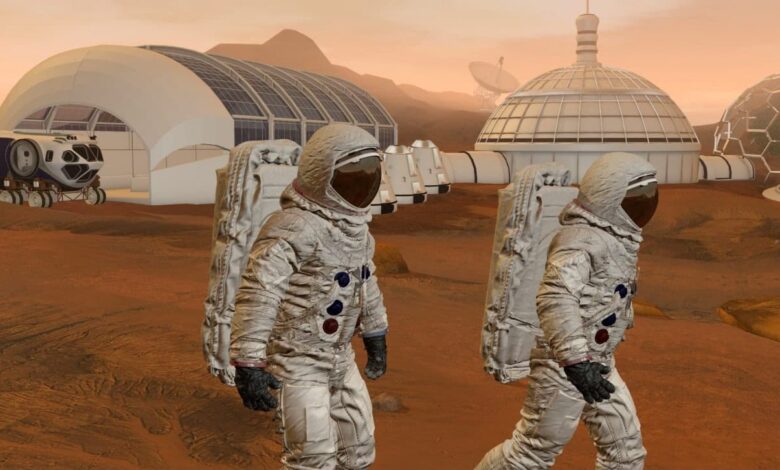
A debate has erupted within the Russian scientific community over the advisability of sending humans to Mars. Igor Mitrofanov, one of the leading experts at the Space Research Institute of the Russian Academy of Sciences, made an unexpected statement: he believes that manned expeditions to the Red Planet could pose a serious threat to humanity. In his view, until there is a definitive answer to the question of whether there is life on Mars, any attempts to bring Martian soil samples to Earth or even simply return with a crew could end in a biological catastrophe.
Mitrofanov stresses that quarantines for astronauts returning from Mars could last for years. However, even such precautions do not guarantee complete safety. He cites Hollywood films where alien microorganisms spark epidemics and notes that a similar scenario cannot be entirely ruled out in real life.
Biological threat
The question of whether life exists on Mars remains open. Recent research has recorded periodic emissions of methane and oxygen near the planet’s surface, which may indicate the presence of simple organisms. On Earth, these phenomena are typically linked to biological activity, while abiotic processes with similar dynamics have not yet been observed.
Mitrofanov points out that the delivery of potentially dangerous microorganisms from Mars to Earth via meteorites is unlikely. Meteorites are exposed to intense heat, radiation, and impacts, making the survival of extraterrestrial life virtually impossible. In the case of crewed missions, however, these natural barriers are absent, increasing the risk of alien life forms reaching Earth.
The Moon as an alternative
Instead of Mars, the Russian scientist suggests focusing efforts on exploring the Moon. In his view, our natural satellite poses no biological threat, and its exploration could be the first step toward establishing extraterrestrial settlements. Mitrofanov is convinced that the Moon could become a new continent for humanity, a place to realize long-term scientific and technological projects.
However, not all experts share this optimism. Some studies suggest the presence of water beneath the Moon’s surface, which implies the potential for microbial life. In addition, it is believed that the Moon formed from material ejected from Earth, which theoretically leaves open the possibility of terrestrial microorganisms existing within its depths.
Scientific debates
In the global scientific community, Mitrofanov’s arguments would spark a vigorous debate. It is well known that terrestrial microbes can survive extreme overloads and radiation, and remain viable even on the surface of the International Space Station. Every year, about 500 kilograms of Martian meteorites fall to Earth, and over the course of human history, their total mass has reached one million tons. Yet, no epidemic linked to extraterrestrial microorganisms has ever been recorded.
Skeptics point out that for an alien microbe to infect a human, it would have to be biochemically compatible with the cells of terrestrial organisms. In practice, this is extremely unlikely, given the differences in living conditions and evolutionary paths. Most known epidemics on Earth have originated in tropical regions with high biodiversity, whereas Mars is more similar in its conditions to Antarctica, where life is virtually absent.
Gravity and Exploration
Another argument against crewed missions to Mars relates to the conditions of microgravity. The Moon’s gravitational force is significantly lower than that of Mars, which could pose a serious obstacle for prolonged human presence. Nevertheless, advocates of lunar exploration believe the Moon is the ideal place to develop the technologies and methods necessary for future interplanetary missions.
The question of whether it is worth taking risks for a scientific breakthrough remains open. While some scientists urge caution and suggest focusing on objects closer to Earth, others insist on the need to continue Mars research despite potential risks.
If you weren’t aware, the Space Research Institute of the Russian Academy of Sciences (IKI RAS) is Russia’s leading scientific center for space science and technology. Founded in 1965, the institute develops and carries out space missions, as well as conducting fundamental research on the Solar System and deep space. Among IKI’s staff are renowned scientists who have made significant contributions to the study of planets and satellites, as well as the advancement of Russia’s space program.