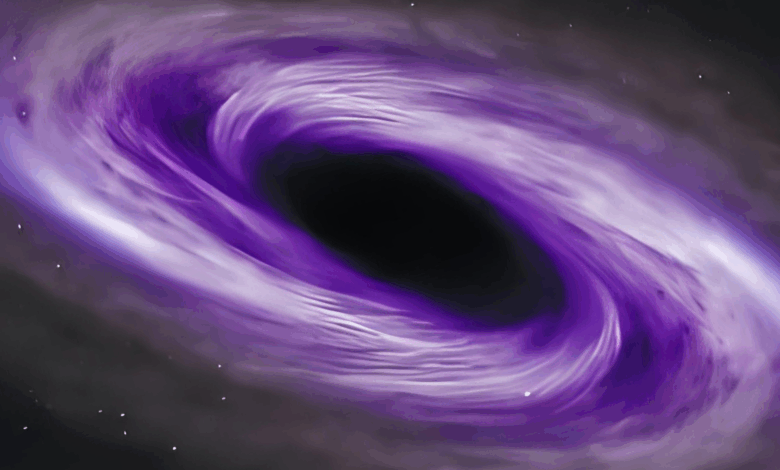
In the very heart of the Universe, 11 billion light-years from Earth, astronomers have encountered a real mystery. In a place where not a single ray of light can be seen, something so massive is hidden that its gravity distorts the very fabric of space. This object, unofficially nicknamed the ‘mysterious destroyer,’ has a mass comparable to a million suns and apparently contains a black hole at its core. But the oddities don’t end there.
Astronomers managed to discover such a distant and invisible object thanks to the effect of gravitational lensing—when light from remote galaxies bends under the influence of powerful gravity on its way to us. It was through these distortions that scientists identified the presence of an unusual body in the JVAS B1938+666 system. However, unlike other known galaxies and star clusters, this object emits no visible light at all. It seems to have dissolved into darkness, leaving only a gravitational imprint behind.
Unusual density
Researchers tried to reconstruct the mass distribution within the mysterious object. It turned out that its central region is incredibly dense—about a quarter of its entire mass is packed into a tiny core, which is typical of black holes or ultra-dense stellar nuclei. But further from the center, the density drops off sharply, forming an extensive disk unlike any known structure in the Universe. This is something entirely new to science.
“We’ve never seen anything like this before,” admit members of the international team. “Objects of this mass usually either shine brightly or have a more uniform distribution of matter. Here, we see an extremely compact core and a huge, but invisible shell.”
Gravitational mysteries
JVAS B1938+666 is a complex system that includes massive galaxies and other objects located between 6.5 and 11 billion light-years away. But it is the “destroyer” that turned out to be the most distant and enigmatic element of this system. It cannot be seen in optical or radio wavelengths—only indirectly, by the way it distorts the light of other galaxies.
By analyzing the tiniest perturbations in the gravitational lens arc, researchers compared the data they obtained to existing dark matter models. None of them could explain such an unusual mass distribution. “It’s not just a dense ball,” the scientists note. “Its structure is something between an ultracompact galaxy and a huge dark matter cloud.”
Searching for answers
So far, all attempts to detect even the faintest light from this object have been unsuccessful. Even the most sensitive radio telescopes have not picked up a single signal. In the future, scientists hope to involve infrared observatories such as the James Webb Space Telescope (JWST). If they manage to detect even a weak emission, it could suggest we are dealing with an unusual dwarf galaxy with a massive halo. But if JWST also sees nothing, it will mean we are facing an object that doesn’t fit into any existing dark matter theories.
“Every time it seems like we’re getting closer to an answer, the object throws us a new curveball,” project members share. “It’s both unsettling and inspiring at the same time. Perhaps we’re on the verge of discovering an entirely new class of cosmic bodies.”
A challenge for science
The discovery of the ‘mysterious disruptor’ has already sparked heated debate in the scientific community. Some believe it could be the key to understanding the nature of dark matter, while others suggest it may be a previously unknown type of galaxy. But so far, none of the hypotheses stand up to the facts. The object remains completely invisible, and its mass and structure defy explanation.
Perhaps it is discoveries like these that move science forward. When familiar models stop working, it creates an opportunity to step into the unknown and discover something truly groundbreaking. Meanwhile, astronomers continue to observe the mysterious object, hoping that new technologies and analysis methods will help shed light on its nature.
RUSSPAIN reminds readers that the Max Planck Institute for Astrophysics in Germany is one of the world’s leading centers for the study of space and gravitational phenomena. Its experts regularly participate in international projects focused on the search and analysis of dark matter, and develop unique methods for modeling mass distribution in the Universe. Thanks to their work, humanity has a chance to come closer to solving the most intricate cosmic mysteries.