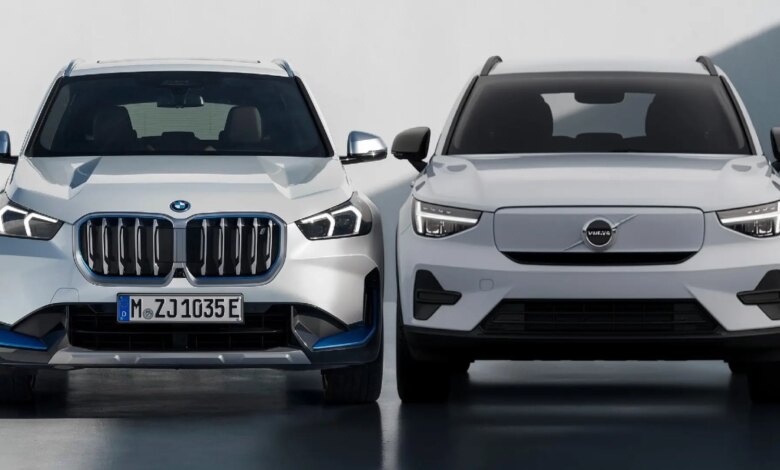
Two premium compact electric SUVs — the BMW iX1 and Volvo EX40 — continue their battle for buyers who value not only eco-friendliness, but also comfort, style, and cutting-edge technology. Both models have entered the market relatively recently, yet have already gained popularity among those seeking a versatile vehicle for city life and long journeys. In 2026, competition between the two has intensified: manufacturers updated trim levels, expanded the range of powertrains, and put a stronger emphasis on digital services.
The premium status of both crossovers is evident not only in their price tags, but also in the quality of materials, level of equipment, and meticulous attention to detail. Buyers deciding between BMW and Volvo face a tough choice: the German marque traditionally focuses on driving dynamics and innovation, while the Swedish brand emphasizes safety, sustainability, and minimalist design. But which one truly gives you more for your money?
Design and interior
The BMW iX1 retains the distinctive traits of the X1 family but features sharper lines and details typical of electric vehicles. Its dimensions are close to its petrol counterpart: 4.50 meters long, 1.84 meters wide, and 1.62 meters high. Inside, there’s generous space for all passengers, especially in the rear, while a 490-liter trunk surprises with its practicality. The rear seats fold down if needed, nearly tripling the available cargo space.
The BMW interior is minimalist without sacrificing functionality. Two large curved panels combine the digital instrument cluster and multimedia center, operated through the BMW ID8 system. Voice assistant controls, numerous settings, and an intuitive interface ensure maximum comfort, although the abundance of features might overwhelm those getting behind the wheel of this model for the first time.
The Volvo EX40, on the other hand, is slightly smaller (4.44 m long, 1.86 m wide, 1.65 m high), yet offers an equally cozy interior. The Swedish brand has prioritized eco-friendly materials and a clean Scandinavian aesthetic. A central vertical panel with a 9-inch screen and integrated Google services looks modern and understated. The seats offer excellent ergonomics, and the build quality is impeccable, though the BMW feels a touch more refined.
Technical Specifications
The BMW iX1 comes in two versions: eDrive20 with front-wheel drive and 204 hp, and xDrive30 with all-wheel drive and 313 hp. Both models are equipped with a 66.5 kWh battery, providing a range from 417 to 474 km depending on the modification. The German crossover delivers excellent dynamics and handling, preserving BMW’s signature character even in its electric version.
The Volvo EX40 offers a wider range of choices: the base Single Motor version (238 hp, rear-wheel drive, 66 kWh battery, up to 479 km per charge), Single Motor Extended Range (252 hp, 79 kWh battery, up to 574 km), and Twin Motor (408 hp, all-wheel drive, 537 km). For thrill-seekers, the Performance package boosts output to 442 hp. This variety lets drivers find the optimal configuration for any need—from city commutes to long-distance travel.
Features and Technology
BMW iX1 is packed with modern options: adaptive cruise control, lane-keeping and automatic parking assistants, an emergency braking system with pedestrian and cyclist detection, plus a host of electronic aids that make every drive safer and easier. Both driver and passengers benefit from a high standard of comfort and smart ergonomics.
Volvo EX40 keeps pace: even the base trim includes adaptive cruise control, LED headlights, Google integration, and a full suite of electronic assistants. Higher versions add premium Harman&Kardon audio, a panoramic roof, 360-degree camera system, and keyless entry. Special attention is paid to safety—a traditional Volvo strength.
Economy and Practicality
The Volvo EX40 starts at €46,950, making it slightly more affordable compared to the BMW iX1, which begins at a minimum of €49,800. At the same time, the Swedish electric SUV offers a wider range of powertrains and a more impressive driving range in its top versions. However, BMW counters with a larger trunk and a slightly more spacious cabin—an important advantage for family trips and long journeys.
Both vehicles deliver high energy efficiency and are well suited for city driving as well as highways. Differences in maintenance and insurance costs are minimal, and Spain’s charging infrastructure—along with the rest of Europe—continues to expand rapidly, addressing many of the concerns about long-distance travel with electric cars.
Driving Impressions
The BMW iX1 retains the brand’s signature features: precise handling, a responsive steering wheel, and a subtle sporty character behind the wheel. Even in its electric version, you can feel the BMW “DNA,” which brand enthusiasts will appreciate. The Volvo EX40, in contrast, focuses on comfort and ride smoothness. Its suspension handles road imperfections exceptionally well and sound insulation is excellent—making each trip quiet and relaxing.
Each model delivers a unique experience: BMW appeals to those who value driving excitement and advanced technology, while Volvo caters to those who seek comfort, safety, and a greener approach. Both crossovers have what it takes to impress even experienced drivers, so the choice between them comes down more to personal preference than objective specifications.
RUSSPAIN reminds readers that BMW is one of Germany’s oldest and most respected car manufacturers, renowned for its innovation and meticulous attention to detail. Volvo, meanwhile, has long been associated with safety, sustainability, and Scandinavian design. Both brands are actively advancing electric vehicle technology and continue to set standards in the premium segment.