The death of Pere Lluís Font was a significant event for the Spanish academic community. His contributions to the development of Catalan philosophy and the translation of classical works have shaped the country’s modern intellectual landscape. Thanks to his efforts, many European thinkers were introduced to Catalan readers for the first time, allowing students and researchers to see the heritage of philosophy from a new perspective.
As reported by El Pais, Font was not only a theologian and translator but also a professor who devoted 36 years to teaching at Universitat Autònoma de Barcelona. His specialization covered modern philosophy and religious thought, and among the authors he translated were Descartes, Kant, Montaigne, Spinoza, and Pascal. He gained particular recognition for his work on “Pensaments i opuscles” (Adesiara, 2021), which earned him the National Translation Prize in 2022. This book is now considered one of the most important contributions to Catalan bibliography in recent years.
A scholar’s journey
Born in the small village of Pujalt in 1934, Font was raised in a family with rural roots. His academic path began at the seminary in La Seu d’Urgell, where he initially planned to become a priest. However, exposure to new ideas prompted him to move to France, where he studied philosophy and theology in Toulouse. After returning to Catalonia, he began teaching at Universitat de Barcelona and later joined UAB, where he worked until his retirement in 2004.
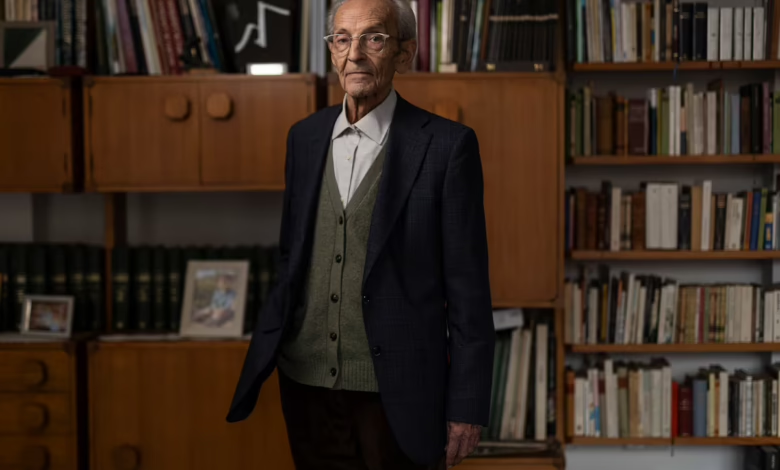
Font was distinguished by strict academic discipline and attention to detail. His colleagues recall that he always arrived on time for classes, invariably dressed in a suit and tie. He was known for his modesty and willingness to share his knowledge, which made him one of the most respected professors at the university.
Contribution to culture
Over the years, Font published dozens of essays and studies on key figures of European philosophy. His translations of Descartes’ “Discurs del mètode” (Edicions 62, 1996), Kant’s “Crítica de la raó pràctica” (Edicions 62, 2003), and Spinoza’s “Tractat de l’esmena de l’enteniment y Cartes sobre el mal” (Edicions 62, 1991) became foundational texts for studying these authors at Catalan universities. Additionally, he coordinated publications on religious thought, expanding the scope of humanities research in the region.
Even after retiring, Font continued to work actively. In 2025, his new works were published: the collection “Poemes essencials” by Joan de la Creu (Fragmenta, 2025) and the essay “La filosofia al natural” (Edicions de la Universitat de Barcelona, 2025). His teaching approach was to introduce students to the most significant ideas of the past through the history of philosophy, emphasizing the understanding and transmission of meaning.
Legacy and recognition
In 2025, Font became the first philosopher to receive the Premi d’Honor de les Lletres Catalanes, recognizing his contribution to the development of Catalan culture. He often noted that the main goal of his career was to teach an understanding of philosophy through its history, giving students the opportunity to ‘converse’ with the eminent minds of the past. His work remains an example for new generations of teachers and researchers.
In recent years, Spain has increasingly recognized the contributions of translators and scholars working with classical heritage. For example, in 2024, a similar award was given to a specialist in Spanish literature for translating Cervantes’ works into modern languages. In 2023, Catalonia discussed the role of translators in shaping national identity, and universities across the country launched new initiatives to support humanities research. These developments show that the preservation and promotion of cultural heritage remain important issues for Spanish society.