If you missed the news about the Luxembourg monarchy, to be honest, you haven’t missed much. The transfer of power from Henri and Maria Teresa is unlikely to become a major topic of discussion, even within the duchy itself. Perhaps this restraint is the trademark of one of Europe’s capitals of ‘quiet luxury.’ This also seems to explain the rare, almost inaudible applause that greeted the new Grand Dukes, Guillaume and Stéphanie, at the end of the ceremony. The kind of public jubilation we are accustomed to did not occur. No passion, no excitement in this tax haven.
Luxembourg is saying goodbye to the most extraordinary Grand Duchess in its history. Maria Teresa became the first Latin American woman to join a European ruling house. She was born in Cuba into a very wealthy family during the Batista dictatorship. Her path into the Nassau dynasty was a difficult one: her mother-in-law, Grand Duchess Joséphine-Charlotte, subjected her to real harassment. But this did not break her. Thanks to her charm and dedication to social causes, she won many people over. Even scandals surrounding her name only added to her allure.
A short haircut, a striking silhouette, bold outfits… Grand Duchess Maria Teresa turned her uniqueness into an asset for the monarchy. Her indomitable character became her shield when a scandal broke out in 2020. It emerged that she had mistreated palace staff and created an “atmosphere of fear.” Accusations of autocratic behavior and strict control, including over her daughter-in-law, Belgian Countess Stéphanie de Lannoy, seemed a logical extension of the image of a woman once scorned for her “humble” origins.
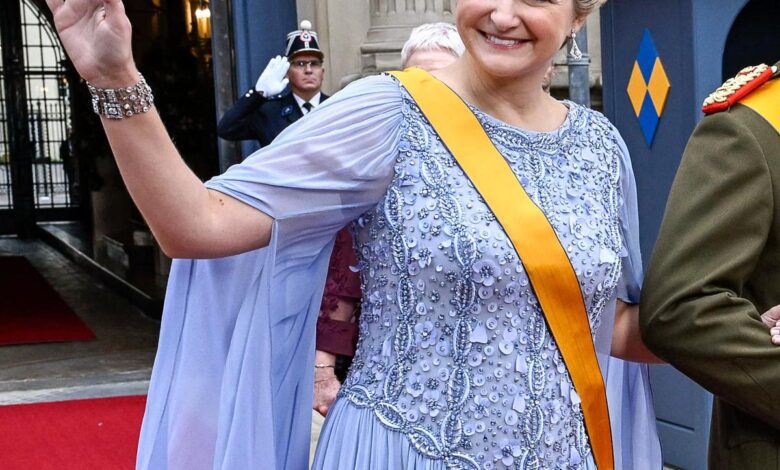
At the abdication ceremony, it was clear that Maria Teresa was in excellent shape and probably looking forward to her ‘golden’ retirement with yachts and private islands. With her departure, the House of Nassau loses its only truly vibrant figure. What is to follow is shrouded in an air of conservatism and dullness. Guillaume and Stéphanie are unlikely to make history for their charisma; they resemble ordinary neighbors from the apartment next door. At the end of the official part, when everyone stood for the final photo, a telling moment occurred. Stéphanie, wearing a fixed smile, approached her mother-in-law. Maria Teresa looked her up and down and ‘congratulated’ her on her choice of outfit. One didn’t need to be a fashion expert to see how horrified Maria Teresa was by the look. While she herself opted for a dress in a striking, fashionable color with an elegant neckline, Stéphanie decided to dress like Elsa from the movie ‘Frozen.’ A choice befitting a seven-year-old girl, but more than odd for a 41-year-old woman. Her dress will go down in fashion fail history—looking as if it had come straight from a 1950s prom.
The new Grand Duchess Stéphanie will have to work hard to match the standards set by other European queens — true style icons and masters of public relations. One only needed to glance at Queen Máxima of the Netherlands and her daughter, Princess Amalia, who looked absolutely stunning. In terms of poise, elegance, and confidence, they are light years ahead of the rest. Although Queen Mathilde of Belgium and Princess Elisabeth were also elegant, their awkwardness on the red carpet in front of parliament did not go unnoticed. It is worth recalling why King Felipe and Queen Letizia, as well as other monarchs, were not present at the ceremony. Tradition dictates that only heads of state and representatives of royal houses from neighboring countries are invited. As a result, aside from the monarchs of Belgium and the Netherlands, the event was attended by representatives of European institutions. The day will end with a gala dinner to be attended by the presidents of Germany and France with their spouses. Perhaps this will be an opportunity to dispel some of the bureaucratic monotony that prevailed throughout the morning.