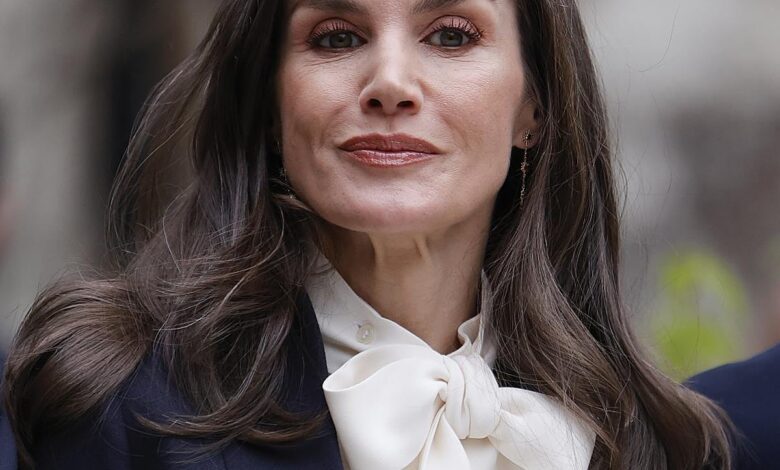
The death of Fernando Onega, one of Spain’s most respected journalists, was not only a personal tragedy for his family but also a significant event for the entire nation. His passing sparked a wave of support and sympathy, with the farewell in Madrid becoming a moment where personal bonds outweighed protocol. Queen Letizia, despite her official status, attended to pay her respects to a family friend—a surprising gesture that drew public attention. According to Mujerhoy, her appearance in mourning attire and her words of comfort to Sonsoles Onega highlighted just how closely the lives of Spain’s public figures are intertwined.
That day, the chapel gathered not only relatives but also colleagues, friends, and journalists from different generations. Letizia was not alone—she was accompanied by Secretariat Chief Marta Carazo, further emphasizing the gravity of the occasion. For many present, it became clear: the Queen was not simply fulfilling formal duties, but genuinely supporting the bereaved in a difficult moment. Recalling her student years, Letizia noted that for journalism students, Fernando Onega was a true role model, a person they aspired to emulate. His influence was felt not just within the professional community, but also in the personal stories of many notable Spaniards.
Family ties
The Onega family has always been known for its unity and mutual support. Sonsoles and her sister Cristina, both of whom chose journalism as their profession, have often emphasized that their father was their main guiding figure. Their relationships with their mother and younger brother Fernando Jr., who became an engineer, were also built on trust and respect. A special place in Fernando’s life was held by his partner, Ángela Rodrigo, who not only supported him in daily life but also once saved his life by donating a kidney. This story became known across the country and stirred a wave of sympathy and admiration.
Despite her painful loss, Sonsoles Onega has not been left alone. She is supported not only by her relatives, but also by close friends—among them, Queen Letizia. Their friendship began over twenty years ago when both worked at CNN+, and it has only grown stronger since then. Sonsoles was a witness at the future monarchs’ wedding, while the royal couple attended her own marriage in Galicia. These details highlight that behind prominent names lie genuine human relationships that withstand the test of time and circumstances.
Personal Circle
In recent years, Sonsoles Ónega has managed to maintain a warm relationship with her ex-husband, lawyer Carlos Pardo Sanz, with whom she shares two children. She is now supported by her new partner — financier Juan Montes, who, according to the journalist herself, helps her balance public life with her personal space. He rarely appears in public but is always by her side at key moments. Another important source of support for Sonsoles is her close circle of journalist friends, with whom she spends time outside of work. Among them are well-known faces from Spanish television, such as María Rey and María Llapart. Their friendship became especially visible in the summer of 2024, when they traveled together through Galicia.
Her sister Cristina, who heads the 24 Horas television channel, remains not only a relative but also a like-minded ally for Sonsoles. Their joint projects, such as the opening of a photography exhibition for a charitable organization, show that family values and professional interests can go hand in hand. On social media, Sonsoles often shares moments from her life with her sister, highlighting their closeness and mutual understanding.
Memory and recognition
The farewell to Fernando Onega was not only a personal event for his family, but also sparked a broad public discussion about the role of journalism in contemporary Spain. The royal household expressed official condolences, noting Onega’s contribution to the development of national media and his unique style. According to many colleagues, it is thanks to such personalities that the profession maintains the trust and respect of society. As Mujerhoy writes, for many young journalists, Onega remains a symbol of honesty and professionalism.
The themes of loss and support from loved ones during difficult times have often become central in other spheres of Spanish life as well. For example, a recent story discussed in the music community focused on Iñaki Antón, who struggled with the passing of Robe Iniesta — more details can be found in the article about how the musician’s life changed after losing his friend. Stories like these show that even the strongest personalities need support and understanding.
Fernando Onega was more than just a journalist; he was a figure who brought together generations of professionals and readers. His writing was marked by precision, irony, and a deep understanding of current events. He authored iconic political slogans, and millions recognized his voice on the radio. For the Onega family, his passing is an irreplaceable loss, but his legacy endures in the work and actions of his children, colleagues, and friends. His life story stands as an example of how personal integrity and professional passion can change not only the course of a single family, but of an entire country.