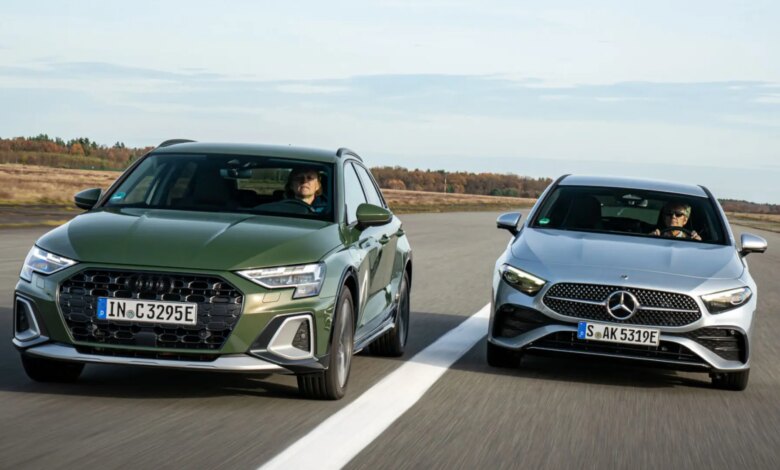
The choice between the Audi A3 allstreet TFSI e and the Mercedes A 250 e is crucial for those seeking not just a hybrid, but a car that truly proves useful in everyday life. It’s not only about saving fuel; it’s also about how convenient the car is to use daily, how quickly the battery charges, and how far it can go on electric power alone. In 2026, these factors have become especially significant, as demands for eco-friendliness and practicality have risen, and the competition among premium hybrids has become fiercer.
According to Autobild, the Mercedes A 250 e has long been familiar to car enthusiasts, while the Audi A3 allstreet TFSI e has only recently entered the market. Despite this, it was Audi that surprised with its electric range—the claimed 132 kilometers is a real breakthrough for this segment. Mercedes, once considered the benchmark, now appears more modest: its battery is rated for 79 kilometers, and in real-world conditions, even less.
Technical details
The Mercedes A 250 e combines a 163-horsepower gasoline engine with a 109-horsepower electric motor, delivering a total of 218 hp and 450 Nm of torque. This setup accelerates to 100 km/h in 7.3 seconds and maintains high speed on the highway. The Audi A3 allstreet TFSI e is slightly less powerful, with 204 hp and 350 Nm, but the difference in dynamics is minimal: it goes from 0 to 100 km/h in 7.4 seconds. At the same time, the Audi offers more confident road grip, especially at launch, where the Mercedes sometimes loses traction due to front wheel slip.
Both vehicles are limited to a top speed of 225 km/h, which is more than sufficient for hybrids in this class. However, in everyday use, maximum speed is less important than how the car handles in the city and on the highway, how smoothly the suspension works, and how quickly the battery can be recharged.
Range and charging
When it comes to range, the Audi A3 allstreet TFSI e pulls ahead. Its 19.7 kWh battery offers up to 132 kilometers on the WLTP cycle, and in real conditions, about 89 kilometers at +5°C. The Mercedes, with a 13 kWh battery, manages a modest 65 kilometers on a single charge. This means Mercedes owners will have to search for an outlet or fuel station more often, while the Audi can go longer without recharging.
Charging speed also matters. The base version of the Mercedes charges from a 3.7 kW source, which takes up to 4.5 hours. For an extra cost, it can be equipped with 11 or even 22 kW charging, reducing time to an hour and a half or just half an hour, respectively. Audi offers standard 40 kW charging, allowing the battery to go from 10 to 80% in just 26 minutes. That’s a serious advantage for those who value their time and don’t want to wait long at the charging station.
Comfort and interior
Inside, the Mercedes A 250 e feels more premium: the materials, build quality, and ergonomics are top-notch. The central screen is large and conveniently positioned, and the MBUX multimedia system is recognized as one of the best in terms of user-friendliness and functionality. The Audi A3 allstreet TFSI e looks modern, but its interior materials are a step behind the competition. The 12.3-inch display is only available with the navigation package, and voice control sometimes responds with a delay.
Both cars come with digital instrument clusters, but Audi’s are designed in a classic style with round dials. The Mercedes’ sport seats impress with their comfort and are included at no extra cost, whereas in Audi you have to pay extra, and the fabric tends to lose its shape quickly. There’s enough rear legroom for passengers up to 1.85 meters tall, provided the driver isn’t too tall. The Mercedes offers a slightly larger trunk — 310 liters compared to Audi’s 280, though with the seats folded down, the difference nearly disappears.
Efficiency and running costs
In mixed driving, the Audi consumes 4.1 liters of petrol per 100 kilometers, while the Mercedes uses 4.6 liters. Additionally, the Audi has a 5-liter larger tank, which means fewer trips to the gas station. This is noticeable in day-to-day use: the Audi stays on the road longer, while the Mercedes needs more frequent attention to its fuel level and battery charge.
The Mercedes has a softer suspension and better absorbs road imperfections, while the Audi, with its higher center of gravity, can sway over bumps and waves. Neither car quite matches its official WLTP figures, but Audi comes closer to the claimed numbers, which matters for those focused on efficiency and range.
The infotainment systems in both cars offer a wide range of features, but you’ll need to pay extra for an extended set of assist systems. The Mercedes is simpler and more intuitive to operate, while Audi implements some functions through its voice assistant, which occasionally makes mistakes. Overall, both vehicles are well-suited for daily driving, but Audi leads in range and charging speed, while Mercedes stands out for comfort and interior quality.
The Audi brand has long been associated with innovation and advanced technology, especially in the hybrid and electric vehicle segment. The A3 allstreet TFSI e represents a significant step forward, thanks to its increased range and fast charging—an appealing choice for those who value practicality and modern solutions. The Mercedes A 250 e, despite its age, maintains a strong position with a high level of comfort and a thoughtfully designed interior, remaining a favorite for those who prefer time-tested technologies and premium quality.