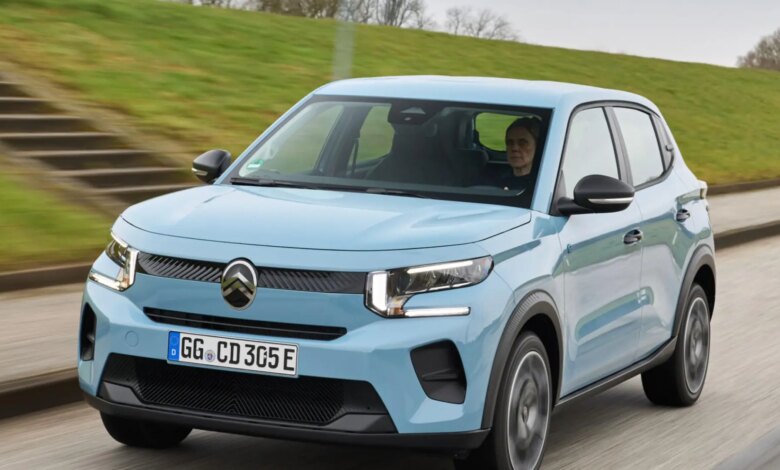
The new-generation Citroën ë-C3 with a 44 kWh battery has entered the market, priced just above 20,000 euros. This compact electric car, assembled at the Stellantis plant in Trnava, Slovakia, is built on the CMP platform, which is used by other models in the group as well. Externally, the ë-C3 stands out among its competitors: it’s not excessively flashy, but it also doesn’t disappear into the crowd. The design is original and modern without trying to chase fleeting trends. Despite being just over four meters long, the car surprises with its spacious interior, especially compared to others in its class.
The high roof provides extra headroom, which tall drivers will particularly appreciate. However, the front seats fall short in terms of ergonomics: they’re quite compact, with soft padding, and can become uncomfortable on long journeys. The second row also has its drawbacks — the battery placement raises the floor noticeably, and the rear seat cushion sits just 285 mm above it. Adult passengers have to sit with their knees sharply bent, which reduces comfort.
Nevertheless, thanks to the considerable interior height (960 mm), even a slight increase in the rear seat height could have greatly improved comfort. The trunk space, however, remains unaffected: just like the gasoline version, it offers between 310 and 1200 liters, which is impressive for a city car. For comparison, the Volkswagen Polo’s trunk ranges from 305 to 1125 liters.
Features and interior
The base trim of the You offers no frills. Among electronic assistants, you’ll find only those required by EU standards and traffic sign recognition. LED headlights, taillights, and a rearview camera are optional extras available with higher-spec versions.
The interior is simple but neatly assembled. The dashboard is minimalist; the base version lacks even a display and navigation. Apple CarPlay and Android Auto are only available in higher trims. In the test model, your smartphone mounts into a special holder, and multimedia functions run through the My Citroën Play app. The steering wheel voice control button interacts with your phone, though this setup isn’t always convenient for daily use.
Performance and comfort
The ë-C3 is unlikely to appeal to driving enthusiasts. The 113-hp electric motor, delivering 125 Nm of torque, can occasionally chirp the front wheels, but overall acceleration is modest. It hits 50 km/h in 4 seconds, and 100 km/h in 10.7 seconds. Top speed is limited to 132 km/h, reached 18.5 seconds after setting off. This car is clearly designed for city driving, not long-distance trips.
However, the Advanced Comfort suspension, familiar from other Citroën models, truly excels here. Despite its short wheelbase (2.54 m), the ë-C3 handles bumps and potholes with confidence. Instead of traditional rubber bump stops, hydraulic dampers are used, allowing the car to smoothly glide over manhole covers and asphalt waves. There are no adaptive dampers or adjustable suspension, but in this segment they aren’t necessary. The only thing missing is a one-pedal driving mode, which would be convenient in city traffic—something Citroën did not implement in this model.
Range and Charging
The ë-C3 is not particularly suitable for long-distance travel. During testing at 7°C, the range was 204 km—a modest figure, but typical for budget electric vehicles. Charging supports up to 100 kW, while on AC it’s limited to 7.4 kW (optionally 11 kW). In ideal conditions, the battery charges from 20% to 80% in 26 minutes.
The limited range slightly offsets the appeal of the low price, but in the electric car segment, the ë-C3 remains one of the most affordable options. It’s a great choice for daily city driving or as a family’s second car.
Practicality and Conclusions
The Citroën ë-C3 does not try to be a sports car. Its strengths are a comfortable suspension, ample city performance, and ease of use. For those seeking an affordable electric car for everyday needs, it’s an appealing option. The final test score is 7.2 out of 10.
For reference, Citroën is a French car manufacturer with a history spanning over a century, and is part of the Stellantis group. The company is renowned for its innovations in comfort and design, as well as its active introduction of electric technologies into the mass market. The ë-C3 model has become one of the brand’s most affordable new electric vehicles, aimed at the European market. Production is based in Slovakia, which has helped keep the price competitive. Citroën continues to expand its electric vehicle lineup, making them increasingly accessible to a wide audience.