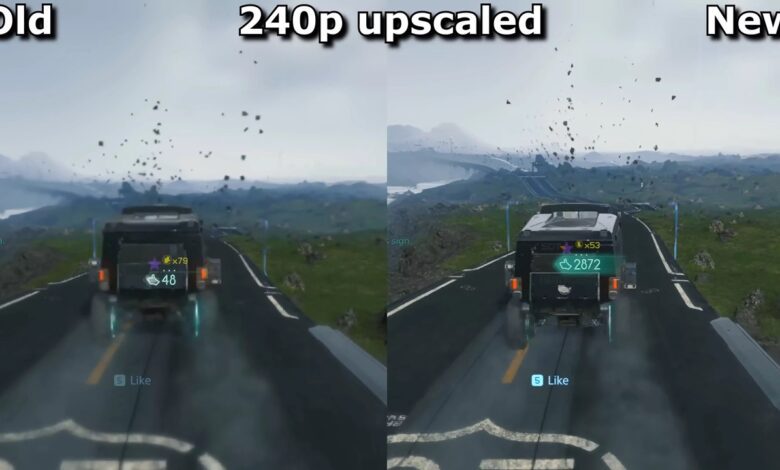
The arrival of NVIDIA’s DLSS 4.5 has the potential to completely transform portable gaming devices. This technology enables modern games to run on minimal settings and then upscale the visuals to high resolution without losing sharpness. For console owners, this means no longer having to choose between performance and image quality. Now, even compact devices can deliver visuals comparable to large stationary systems.
At the core of DLSS 4.5 is artificial intelligence that analyzes every frame and reconstructs details that would otherwise be lost with standard rendering. As a result, games launched at 240p resolution can look almost like Full HD or even 4K. This approach not only conserves resources but also reduces power consumption, which is especially important for portable consoles. According to MuyComputer, the new version of DLSS uses five times more parameters than previous generations and runs on FP8, allowing faster frame processing and reduced latency.
Console possibilities
DLSS 4.5 unlocks new horizons for portable device manufacturers. It is now possible to create consoles that don’t require powerful or expensive graphics chips, yet still provide high-quality graphics. Previously, for example, the Nintendo Switch 2 could upscale images from 540p to 1080p, but with DLSS 4.5 a similar result can be achieved starting from 360p or even 240p. This reduces hardware demands, lowers heat output, and makes devices lighter and more autonomous.
Another important advantage is the reduction of cooling system noise. With less load on the graphics processor, the fans run more quietly and the device remains cool. For users, this means greater comfort and the ability to play longer without recharging. Additionally, lower component costs could lead to more affordable models appearing on the market.
Market potential
The introduction of DLSS 4.5 may become a key factor for manufacturers aiming to lead the handheld console segment. Should a device emerge supporting this technology and graphics based on Ada Lovelace or Blackwell, it would offer users an unprecedented combination of power and battery life. According to MuyComputer, such solutions have not been implemented yet, but the technical capability already exists.
NVIDIA’s partnership with Intel also opens up new opportunities. Joint development of a processor on the x86-64 architecture and the integration of modern graphics cores would make it possible to bypass ARM limitations and ensure compatibility with a wide range of games. Such a chip could include eight energy-efficient cores and a GPU capable of operating with DLSS 4.5, giving the device an edge over competitors.
Industry impact
The emergence of new portable consoles with DLSS 4.5 support could shift the balance of power in the market. Users will gain access to high-quality graphics games even on affordable devices, while manufacturers can lower production costs and extend battery life. This will lead to increased competition and the arrival of new players in a segment that has long been dominated by a few major companies.
At the same time, not all existing devices will be able to take advantage of DLSS 4.5. For example, Nintendo Switch 2 does not support FP8, which means it cannot work with the new version of the technology. This creates an opportunity for new models focused on delivering maximum performance with minimal energy consumption.
NVIDIA is one of the world’s leaders in graphics solutions and artificial intelligence. The company is known for its innovations in graphics cards and gaming technologies, as well as partnerships with major electronics manufacturers. In recent years, NVIDIA has been actively developing portable devices and cloud services, aiming to make modern games accessible to a wide audience. The DLSS technology has become one of the company’s key achievements, enabling improved graphics quality without increased hardware requirements.