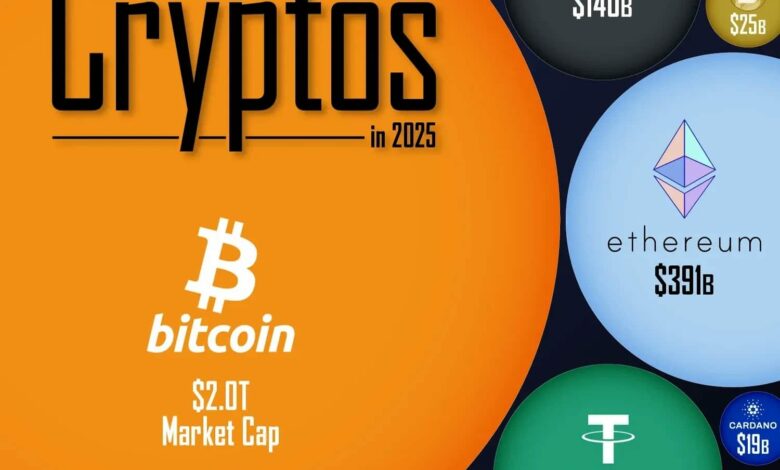
In 2025, digital currencies continue to attract attention from investors and analysts worldwide. The cryptocurrency market shows significant fluctuations, with its leaders maintaining impressive capitalization volumes. The most valuable coins not only set trends in financial technology but also influence global economic processes.
Bitcoin has once again confirmed its status as the leading cryptocurrency. As of November 11, its total value reached nearly two trillion dollars, emphasizing its sustained dominance. However, by the end of the month, its capitalization had fallen to $1.75 trillion, highlighting the market’s high volatility.
Ethereum holds the second-largest capitalization. By mid-November, its value was around $391 billion, dropping to $352 billion by November 25. Ethereum remains a key platform for creating decentralized applications and smart contracts, sustaining its popularity among developers and investors.
Market dynamics: Emerging and stable leaders
Among other notable players is Tether (USDT)—a stablecoin pegged to the US dollar. Its capitalization steadily holds at $184 billion, making it one of the most sought-after tools for storing and transferring funds in the digital economy.
The top five also include XRP and BNN. On November 11, XRP’s market capitalization stood at $140 billion, dropping to $134.7 billion by the end of the month. BNN showed a similar trend, falling from $128 billion to $118.6 billion. These cryptocurrencies continue to draw attention due to their technological features and active ecosystem development.
Solana, USDC, TRON, Dogecoin, and Cardano also made it into the top ten digital currencies. Each of these projects offers unique solutions and technologies, enabling them to maintain strong positions in the market even amid volatility.
Influencing Factors and Development Prospects
The rise and fall of cryptocurrency capitalization are directly linked to changes in the global economy, regulation, and technological innovation. Investors closely monitor the news to respond promptly to price fluctuations and select the most promising assets.
Bitcoin and Ethereum continue to set the pace for the entire market, but the emergence of new projects and growing competition among stablecoins and decentralized application platforms could shift the balance in the coming years. Experts note that further development of the sector will depend on the adoption of new technologies and adaptation to regulatory requirements.
Despite periodic corrections, interest in digital currencies remains strong. Major institutional investors and private individuals continue to view cryptocurrencies as an alternative to traditional financial instruments, supporting high liquidity and trading volumes in the market.
RUSSPAIN Reference. What is Bitcoin and Why Does It Matter?
Bitcoin is the first and most well-known cryptocurrency, created in 2009 by an individual or group using the pseudonym Satoshi Nakamoto. Its main feature is a decentralized system independent of banks and government authorities. Bitcoin operates on blockchain technology, which ensures transparency and security for all transactions. Over the years, Bitcoin has become not only a means of exchange but also an investment asset and a symbol of the new digital economy. Today, it is used for international transfers, capital storage, and even payments by some companies around the world.
Earlier, we took a detailed look at the global distribution of rare earth metal reserves and why China and Brazil control the majority of these resources. This data has a significant impact on technological progress and the overall economy. If you are interested in topics such as global resource allocation and how it shapes new markets, we recommend reading the article on rare earth metal reserves. The article highlights the key aspects of how these elements impact the global economy and technological progress.