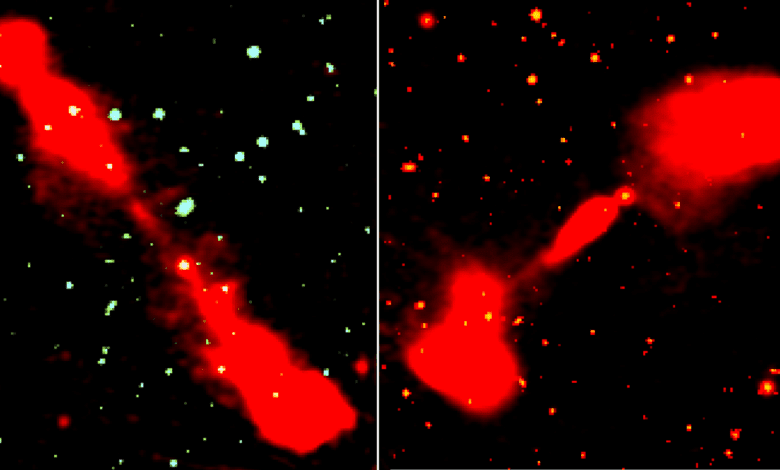
A team of Indian astronomers has made a breakthrough in the study of the Universe, discovering 53 new quasars with truly colossal radio jets. Powered by supermassive black holes, these objects eject streams of matter over distances more than 50 times the diameter of the Milky Way. Some jets extend up to 7.2 million light-years, making them among the largest cosmic structures known today.
The discovery was made possible thanks to data collected by the Giant Meterwave Radio Telescope (GMRT), located near Pune, India. As part of the extensive TIFR GMRT Sky Survey (TGSS), scientists analyzed about 90% of the visible sky, identifying 369 radio quasars, among which these giants were found.
Giant radio jets
The quasars in question are active galactic nuclei with supermassive black holes at their centers, ranging from millions to even billions of solar masses. However, not every such black hole becomes the source of a bright quasar; enormous reserves of gas and dust are needed to form an accretion disk around the black hole.
During the accretion process, some matter is not absorbed but instead expelled outward in the form of powerful jets. These plasma streams, accelerated to near-light speeds, burst through galactic space and form gigantic radio lobes observable millions of light-years from the galactic center.
Structural features
One of the study participants, Souvik Manik, notes that the dimensions of the observed radio jets are incomparable not only to the Solar System, but even to our galaxy. According to him, we are talking about scales where 20–50 Milky Ways could be lined up along a single jet.
Such objects are extremely rare and hard to detect. The reason is that the faint radio emission linking the two lobes often falls below the sensitivity threshold of instruments, making the structure appear fragmented or incomplete. It is precisely low-frequency radio observations, such as TGSS, that enable scientists to identify these ancient and vast formations.
Environmental impact
Scientists have noted that about 14% of giant radio quasars are located in galaxy clusters or near cosmic filaments—areas where gas, dust, and dark matter are concentrated. As it turns out, the surrounding environment significantly influences the development and shape of radio jets.
In denser regions of space, jets can slow down, bend, or even break up under the influence of surrounding gas. In less crowded areas, the jets can travel freely across vast distances, forming symmetrical lobes. However, even in such conditions, asymmetry is often observed: one jet may end up longer or brighter than the other.
Asymmetry and evolution
Researchers note that the asymmetry of radio jets is a fairly common phenomenon. This indicates that jets collide with a heterogeneous intergalactic medium. On one hand, the jet may encounter a dense cloud of gas that slows its movement, while on the other, it can travel nearly unimpeded.
Interestingly, the farther away a quasar is from us, the more pronounced the asymmetry of its radio jets. This may be because in the early Universe, denser and more chaotic conditions prevailed, distorting the paths of these jets. Studying such objects not only sheds light on the processes within galaxies but also provides insights into the state of the cosmic environment during different epochs.
If you didn’t know, the Giant Meterwave Radio Telescope (GMRT) is the world’s largest radio telescope operating at meter wavelengths. It consists of 30 antennas, each 45 meters in diameter, and is located in India, near Pune. GMRT is actively used to study distant galaxies, quasars, and other cosmic objects, as well as to search for new phenomena in the Universe. Thanks to its high sensitivity and wide sky coverage, the instrument enables astronomers to make discoveries that change our understanding of the cosmos.