The jewel of the Alcarria region has received the highest honor in rural tourism. The picturesque municipality of Brihuega, whose endless lavender fields turn the landscape bright purple every summer, has been named the ‘Magical City of 2026.’ This award recognizes its successful transformation from an agricultural identity into a top-tier tourist destination that respects both nature and the local community. The key to its success has been a commitment to sustainability and the preservation of its rich heritage.
The town of Brihuega in the province of Guadalajara, often referred to as the ‘Spanish Provence,’ took over the title from Cabra (Córdoba) following a public vote with more than 250,000 participants. This victory is the result of smart tourism management that combines history, beauty, and a modern approach. The ‘Magical Cities of Spain’ Association emphasized that Brihuega managed to win the public’s hearts while staying true to its authenticity, establishing itself as an international benchmark. The honorary award, marking its growing recognition abroad, will be presented at the next International Tourism Fair, FITUR 2026.
Brihuega’s treasures
In addition to the intoxicating aroma of its famous lavender fields, Brihuega boasts a rich monumental heritage that has earned it the highest recognition. Declared a historic complex, this municipality offers a true journey through time along its narrow, winding streets. Here, the typical architecture of Alcarria blends harmoniously with impressive medieval buildings and romantic gardens, inviting visitors to explore every corner.
One of the most unique buildings is the Royal Cloth Factory, which once housed up to a hundred looms. Next to this majestic structure stretch French-style gardens, which Camilo José Cela poetically described in his ‘Journey to the Alcarria’ as a place ‘where you could die of love.’ Today, this complex is home to a five-star hotel, which has become a magnet and a catalyst for the entire area. The town has also preserved an imposing limestone wall that protected it for five centuries. A walk along this wall allows you to appreciate its former might and see surviving gates, such as the impressive Cozagón Arch.
Inside the walls lie true gems: the Cistercian church of Santa María de la Peña, home to the Romanesque statue of the town’s patron saint, and the Castillo de Piedra Bermeja. In its inner courtyard, you’ll find a beautiful romantic cemetery, while the terrace offers one of the best panoramic views of Brihuega and the Tajuña Valley. Don’t miss the labyrinth of Arab caves—a network of galleries and tunnels running through the historic center of the city.
The Scent of the Spanish Provence
Just an hour from Madrid, Brihuega’s landscape undergoes a stunning transformation in mid-July. At the peak of lavender bloom, nearly 1,000 hectares of fields turn a deep shade of violet, evoking images of the famous French Provence. This municipality is recognized as one of the world’s largest producers of this aromatic plant.
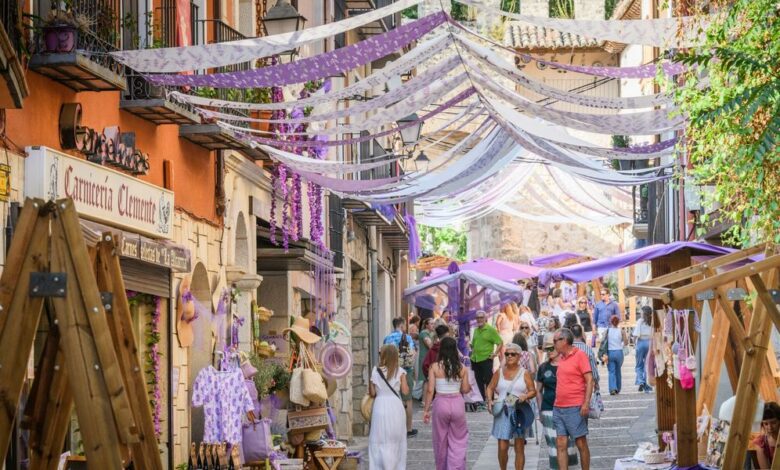
Ten years ago, this natural spectacle inspired the Lavender Festival, which quickly became a must-visit event. At sunset, music and nature meet here in a magical atmosphere. The festival has played a key role in attracting thousands of tourists and strengthening the region’s appeal. During the blooming days, the entire city is transformed: field tours are organized, sensory workshops are held, and a lively Lavender Market fills the streets.
A Constellation of Magical Towns
At a special ceremony held as part of FITUR, not only will the achievements of Brihuega be recognized. The ‘Pueblos Mágicos de España’ network will also honor other municipalities that have excelled in key areas of rural development. Campo de Criptana (Ciudad Real) received an award for rural tourism development, while Escalona (Toledo) was recognized for heritage preservation and promotion. In the category of unique cultural events, the prize was shared by Salar (Granada) and Almedinilla (Córdoba).
Other winners include Orcera (Jaén) for promoting local products, Vilaller (Lleida) for natural area management, and Utrera (Seville) for successful public-private partnerships. The ‘Magic Monument’ award went to La Calahorra Castle (Granada). Frómista (Palencia) was recognized for preserving traditions, Cómpeta (Málaga) for active tourism, and Vícar (Almería) for supporting traditional commerce.
For reference, ‘Pueblos Mágicos de España’ is an initiative aimed at promoting communities with unique charm and rich heritage. The network brings together towns and villages that offer tourists more than just beautiful scenery. The main goal of the project is to promote sustainable rural development, combat depopulation, and create new economic opportunities while preserving the cultural and natural identity of each place.