An unusual route has emerged in the Murcia region for fans of contemporary Spanish literature. Journeying through the places that inspired the novel “The Curse of the Big House” (La maldición de la casa grande) by Juan Ramón Lucas lets travelers see Portmán, La Unión, and Cartagena through the eyes of the book’s characters. Every corner here preserves echoes of a mining past, family conflicts, and dramas that run through the heart of the story.
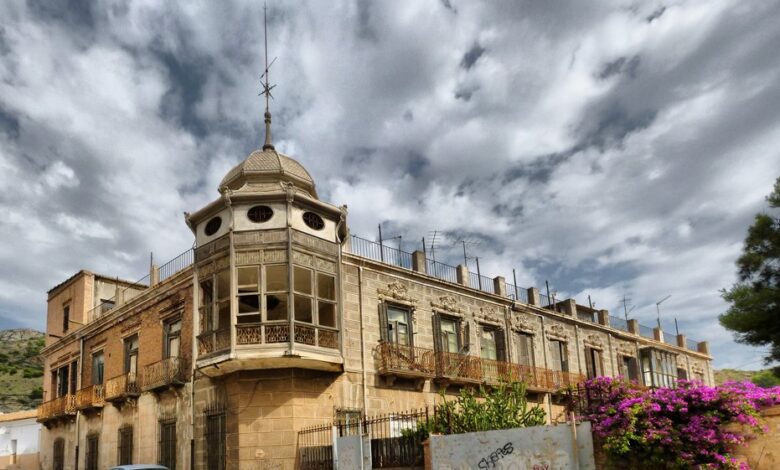
The route begins in Portmán—a small village on the Mediterranean coast that once thrived thanks to mining. Here, the author set the fictional “Big House,” modeled after the famous Casa del Tío Lobo. The atmosphere immediately sets a tense mood: historic buildings, abandoned mines, and stunning landscapes serve as reminders of lost grandeur and the tragedies intertwined with the history of local dynasties.
Portmán: A Past That Became Legend
The first steps along the route lead to Portmán’s landmark sites. The archaeology museum, once a hospital for miners, tells the story of the workers’ tough daily lives. The Church of Santiago Apóstol (Iglesia de Santiago Apóstol) reflects the town’s industrial heyday, while the old cemetery with family tombs gives a sense of the scale of the families who played a key role in its economic boom.
From the heights of the Mirador del Lastre viewpoint, you can see a panorama where the sea meets the mountains and the old fishing port stretches out below. It’s easy to imagine the novel’s characters whose lives are deeply intertwined with these places. In every house and on every street, there’s a subtle line between fiction and reality, while the figure of the legendary “Tío Lobo” seems to linger in the air.
La Unión and Cartagena: Mines, Ambitions, and Change
The route continues on to La Unión—a city where the mining past is still evident in both its architecture and landscape. Here, you’ll find historic viewpoints like Descargador and Camino del 33 offering sweeping vistas of the former mines. In the city center, buildings tied to the industrial boom have been preserved: La Maquinista de Levante, Mercado Público, Casa del Piñón, and the famous Rojo el Alpargatero café. These sites reveal how a unique way of life took shape here, where family ties, economic interests, and hidden tragedies are closely intertwined.
The final point of the route is Cartagena. Here, travelers can visit the old Fundición Dos Hermanos factory and the Venta del Llano del Beal—locations that play a pivotal role in the novel’s plot. These sites reveal the connection between real events and fiction, and show how the memory of the mining past takes on new meaning.
Family Secrets and Mining Heritage
At the heart of the story is the saga of a powerful family, inspired by the real-life clan of ‘Tío Lobo.’ Their wealth and influence soared during the mining boom of the late 19th and early 20th centuries. Yet behind the façade of splendor lie generational dramas and a curse that has become a symbol of destructive ambition and lost hope.
Lucas’s novel not only traces the fate of a single family, but also reveals how the past shapes the present across an entire region. Every stop along the route is more than just a landmark—it’s a piece of a complex mosaic where personal stories intertwine with the history of Murcia.
The author and his contribution to culture
Juan Ramón Lucas is a prominent Spanish journalist whose career spans radio, television, and print media. Over the years, he has received numerous professional awards, including prestigious prizes in television and radio. In addition to journalism, Lucas is involved in literature and producing, and he also participates in charitable projects.
‘The Curse of the Big House’ has become one of his most notable works of fiction. The book and the route inspired by it offer a new perspective on Murcia, letting you feel the breath of history and reflect on how the past shapes the fates of people and entire cities.