On the Catalan coast, nestled among pine groves and overlooking the endless sea, lies a place whose history is shrouded in centuries-old mystery. Today, Sant Martí d’Empúries appears as a serene medieval village firmly connected to the mainland. But its past holds a remarkable enigma: it was once a bustling Greek island, a key port in the Mediterranean, which eventually merged with the coastline, leaving historians with more questions than answers.
From Island to Mainland: A Geological Metamorphosis
The chronicles of this place date back more than two and a half millennia. In the 6th century BC, colonists from Phocaea founded the first Greek colony on the Iberian Peninsula on a rocky island just a few hundred meters from shore. This patch of land, named Palaiópolis, meaning ‘old city,’ enjoyed a unique strategic advantage. Situated between marshy lowlands and the mouth of the Fluvià River, it was the perfect spot to control sea routes and trade.
Nature, however, proved stronger than human ambition. The relentless passage of time, river sediment, and the gradual retreat of the sea brought about a true marvel. For centuries, sand and silt filled the strait until a natural isthmus finally formed, forever connecting the island to the mainland. Thus, what was once an isolated Hellenic outpost became an integral part of the Catalan coast, its insular origin turning into a legend buried beneath layers of earth.
A Kaleidoscope of Civilizations
After the Greeks, this land witnessed many peoples. The Romans expanded the settlement, founding a new city on the mainland. Then came the Visigoths, who made Sant Martí the center of a bishopric. Later, the Muslims and the Franks of Charlemagne left their mark here. For centuries, the settlement served as the capital of the County of Empúries, an important political and religious center, and the scene of numerous battles and intrigues.
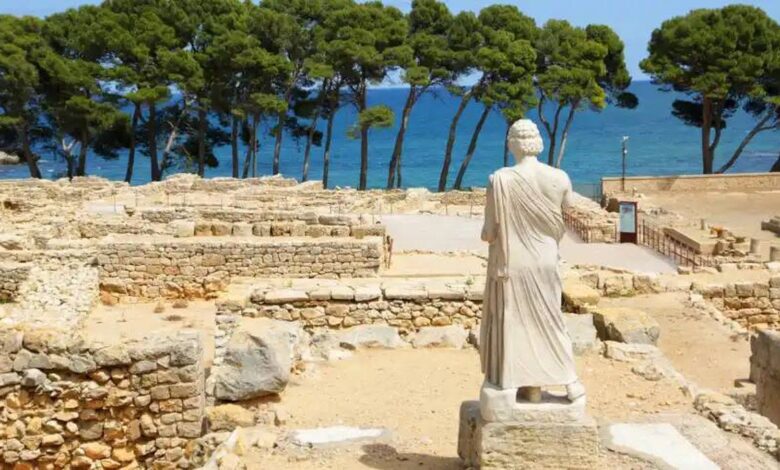
However, from the 11th century, its star began to fade, and its former glory gradually waned. Fortunately, the city never vanished completely. It remains frozen in time, preserving its rich heritage for future generations. Today, as you stroll through its narrow streets, you can see fragments of medieval walls, stone houses built between the 15th and 18th centuries, and the majestic fortified church of 1538, erected atop the ruins of even more ancient temples.
A Living Legacy
Recognized as a site of national cultural heritage, Sant Martí d’Empúries has preserved its unique atmosphere. Every stone here breathes history, from the central square to the old building that now houses the Iberia Graeca center for Greek heritage studies. This place is so colorful that it even inspired writer Víctor Mora to make it the fictional home of his famous character, Capitán Trueno.
Today, this corner of Catalonia attracts not only history enthusiasts, but also those who appreciate Mediterranean beauty. Quiet beaches, picturesque walking trails with panoramic views of Cap de Creus, and a well-kept promenade linking the village with the Empúries archaeological complex and the neighboring town of L’Escala make it an ideal spot for leisurely strolls, where history and the sea become one.